Morning Lux Exposure: 10,000-Lux Photon Capture for SCN Clock Anchoring
Why stepping outside into direct solar photons within thirty minutes of waking triggers the master circadian domino effect, eliminating morning grogginess and guaranteeing rapid sleep onset fourteen hours later.
Key Photobiology Rules
- The 10,000-Lux Threshold: Melanopsin-expressing retinal cells require a critical threshold of photon energy (typically $\ge 10,000\text{ lux}$) to stimulate gene expression of c-Fos in the suprachiasmatic nucleus.
- Window Glass Filtering: Modern low-E architectural glass blocks up to 80% of blue-spectrum photons. Looking through a closed window is physiologically insufficient.
- Retinal Topography: ipRGCs are concentrated in the inferior half of the retina, designed by evolution to capture light descending from the sky above the horizon.
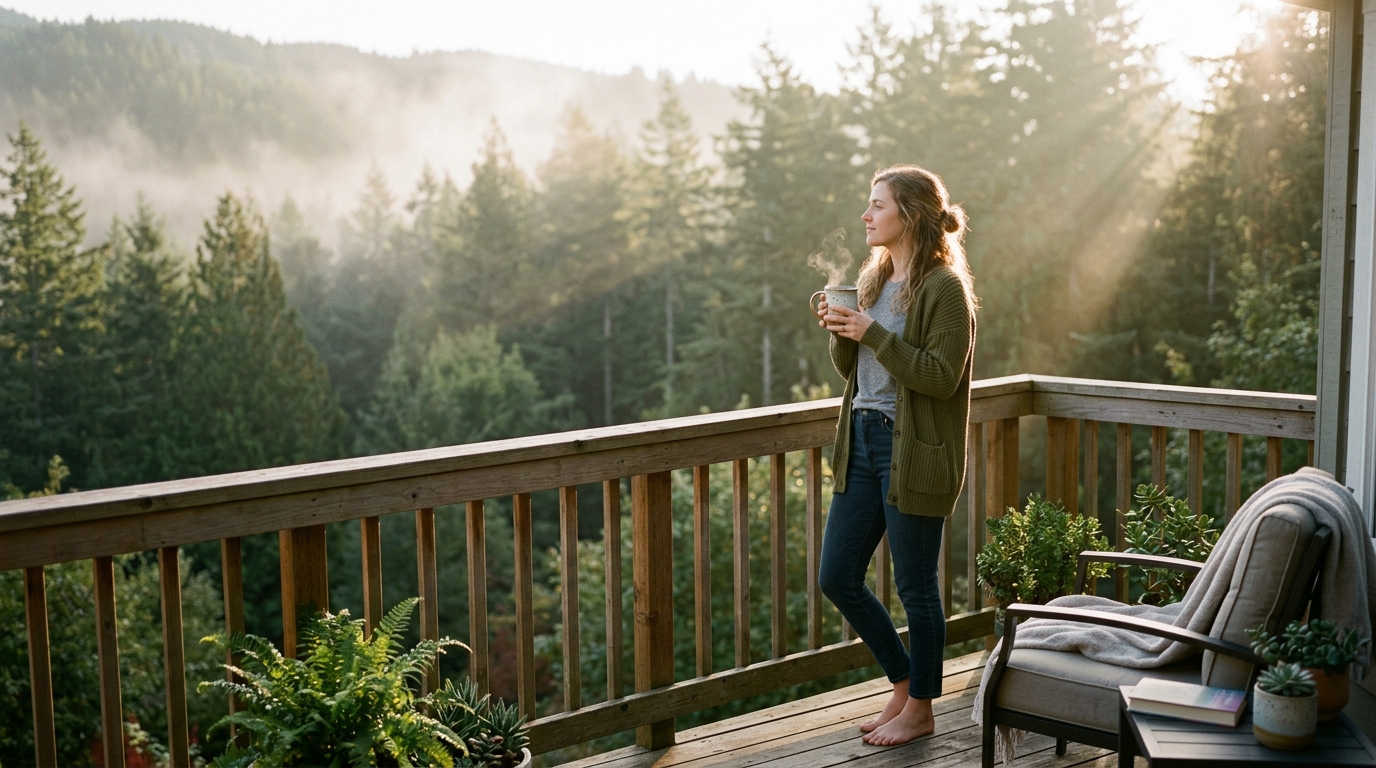
1. The Biological Darkness of Modern Indoor Life
Human biology evolved over millions of years outdoors under the radiant spectrum of the sun. In prehistoric environments, our ancestors were bathed in 10,000 to 100,000 lux of full-spectrum photons during the morning and afternoon, followed by total darkness punctuated only by the amber glow of wood fires (0.1 to 5 lux) at night.
Today, the average knowledge worker lives in what chronobiologists call "circadian twilight." We wake up in dimly lit bedrooms, commute inside vehicles with tinted glass, and sit under fluorescent office lighting producing a measly 300 to 500 lux. Then, after dusk, we stare directly into backlit LED monitors and smartphones producing 150 to 300 lux of high-energy blue photons inches from our retinas.
To the suprachiasmatic nucleus (SCN), our daytime environment looks like deep biological darkness, while our nocturnal environment looks like blazing midday sunshine. This mismatch flattens the amplitude of the 24-hour circadian rhythm, leaving professionals perpetually exhausted by day and unable to achieve deep sleep by night.
2. The Physics of Photon Density: Outdoors vs Indoors
The human eye adapts so seamlessly to ambient light that subjective perception of brightness is entirely untrustworthy. The pupil dilates in dark rooms to gather light, creating the psychological illusion that an office is "bright":
Modern Office Lighting (~400 Lux)
Even in a well-lit corporate boardroom with floor-to-ceiling recessed LEDs, illuminance rarely exceeds 400–500 lux. While sufficient for reading text on paper, this photon density is two orders of magnitude below the biological activation threshold required for robust melanopsin isomerization.
Morning Sunlight (10,000–100,000 Lux)
Even on a grim, rainy winter morning in Seattle or London, outdoor ambient light delivers 10,000 to 15,000 lux. On a clear, sunny morning, outdoor illuminance easily surpasses 80,000 lux. Photons flood the eyes from all angles, saturating ipRGCs within minutes.
3. The Retinal Mechanism: How Melanopsin Signals the SCN
Inside the human retina, approximately 3,000 to 5,000 specialized cells—known as M1 intrinsically photosensitive retinal ganglion cells (ipRGCs)—function as biological light meters. These cells express melanopsin, an ancient photopigment structurally homologous to invertebrate rhodopsin.
When blue-green photons (460–480 nm) strike melanopsin, it initiates a G-protein-coupled signaling cascade that depolarizes the neuron. These cells project their axons along the retinohypothalamic tract, terminating directly in the ventrolateral SCN.
Within the SCN, this incoming electrical signal activates c-Fos and Per1/Per2 gene expression. This molecular reset accomplishes two critical physiological tasks:
- It triggers an instantaneous pulse of adrenocorticotropic hormone (ACTH), creating the Cortisol Awakening Response (CAR) that clears morning grogginess and mobilizes energy.
- It sets an internal biological countdown timer: approximately 14 to 16 hours following morning photon capture, the pineal gland will begin releasing endogenous melatonin.
4. The Protocol: How to Execute Morning Photon Capture
To calibrate your circadian master clock for peak executive alertness, follow this clinical routine:
| Condition | Required Duration | Key Execution Directive |
|---|---|---|
| Sunny Morning (Clear Sky) | 10 Minutes | Look generally in the direction of the sun without staring directly at it. Do NOT wear sunglasses (corrective eyeglasses or contact lenses are fine). |
| Partly Cloudy Morning | 15 Minutes | Step completely outside. Take a light walk around the block or drink your morning electrolyte water on a balcony or patio. |
| Dense Overcast / Rainy Morning | 25–30 Minutes | Photon density is lower; duration must be increased proportionally to accumulate sufficient photon mass. |
| Dark Winter Morning / High Latitudes | 20 Minutes | Utilize a certified 10,000-lux seasonal daylight box positioned 12–16 inches away at a 45° downward angle while working at your desk. |
5. The Compounding Dividends: Executive Focus & Metabolism
When knowledge workers strictly anchor their morning lux exposure, the clinical benefits ripple far beyond simple sleep improvement. Controlled studies show that proper SCN entrainment elevates daytime dopamine tone by up to 30%, enhances whole-body insulin sensitivity by synchronizing peripheral pancreatic clocks, and reduces evening cognitive cravings. By honoring the retinal physics of light, you reclaim biological control over your energy.
Frequently Asked Questions: Morning Photon Capture
Why can't I just get morning light through a window or windshield?
Standard modern window glass and automotive windshields are treated with low-emissivity (low-E) and UV/blue filtering coatings. This glass attenuates photon density by 50% to 80% and shifts the spectral composition away from the critical 460-480nm melanopsin absorption peak. You would need to sit behind a closed window for several hours to achieve the photon threshold delivered by 10 minutes outdoors.
How long should I stay outside on an overcast or cloudy morning?
On clear, sunny mornings, 10 minutes of outdoor exposure delivers approximately 50,000 to 100,000 lux, which is more than sufficient. On densely overcast or rainy mornings, ambient lux drops to 10,000–15,000 lux. To compensate for reduced photon density, extend your outdoor exposure to 20–30 minutes.
Can artificial light boxes replace natural sunlight during winter?
Yes, if they produce certified 10,000-lux output at a functional distance (typically 12 to 16 inches). Position the light box at roughly a 45-degree angle above eye level to stimulate the inferior retina, where melanopsin-containing ipRGCs are most densely concentrated.