Adenosine Clearance Curve: The 90-Minute Morning Caffeine Delay Protocol
Why reaching for coffee within minutes of rolling out of bed is the direct biological cause of your mid-afternoon cognitive slump, and how a 90-minute delay transforms your daily energy trajectory.
Key Purinergic Principles
- The Adenosine Debt: Adenosine is a natural byproduct of cellular energy consumption (ATP hydrolysis). The longer you are awake, the higher extracellular adenosine climbs, driving homeostatic sleep pressure.
- The Competitive Block: Caffeine has high structural homology to adenosine. It occupies A1 and A2A receptors without activating them, temporarily masking fatigue while adenosine continues accumulating.
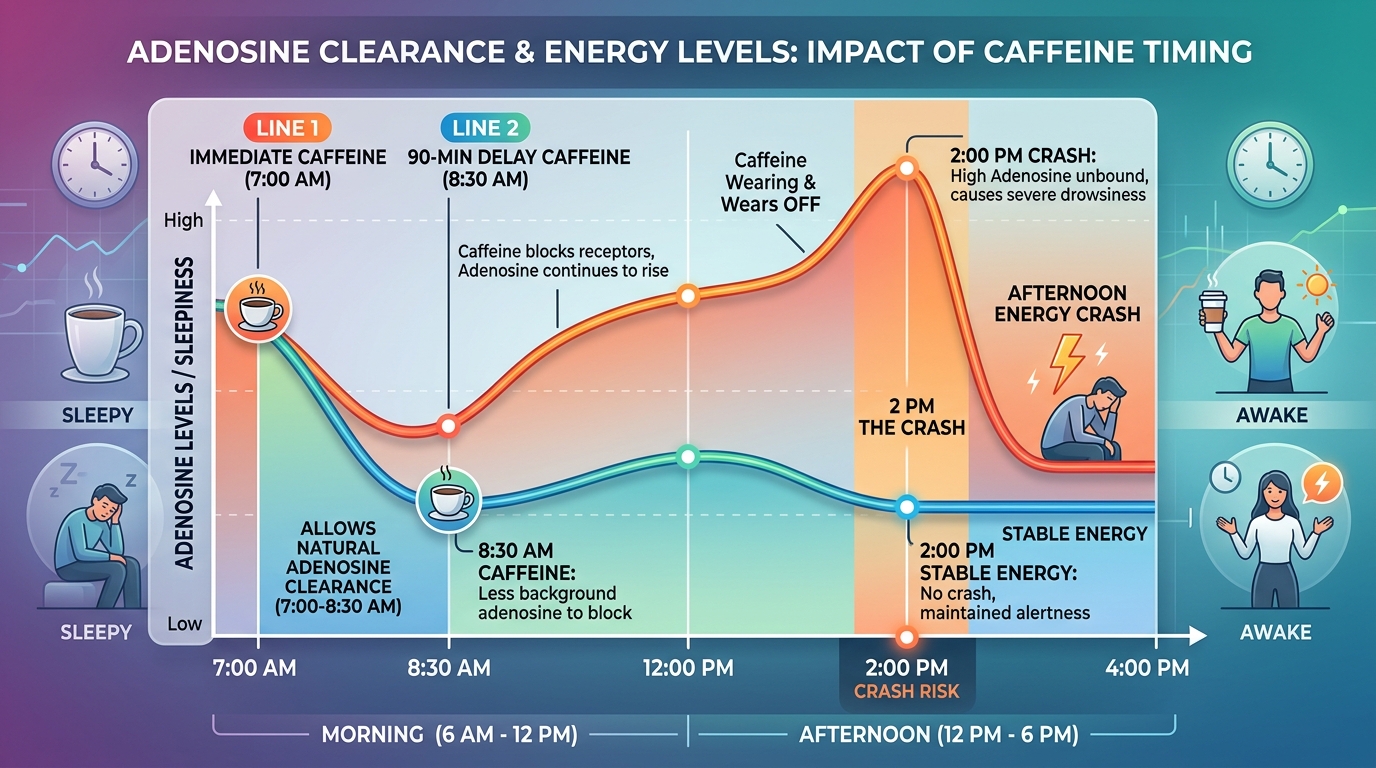
- The CAR Synergy: Delaying caffeine by 90 minutes allows the morning Cortisol Awakening Response to clear residual nocturnal adenosine naturally, preventing the post-lunch receptor flood.
1. The Purinergic Clock: How Adenosine Dictates Alertness
Every second you are alive and thinking, your brain cells consume millions of molecules of Adenosine Triphosphate (ATP) to fuel synaptic transmission and ion pumping. As ATP loses its three high-energy phosphate bonds, it degrades sequentially into ADP, AMP, and ultimately free adenosine.
Throughout the waking day, this free adenosine diffuses into extracellular space and binds to inhibitory A1 and A2A adenosine receptors located on arousal-promoting neurons in the basal forebrain and cortex. As receptor occupancy climbs from 20% to 80%, neural firing rates slow, eyelids grow heavy, and the subjective sensation of "sleep pressure" intensifies.
During healthy slow-wave sleep, the brain clears this accumulated pool of adenosine through astrocytic reuptake and enzymatic conversion by adenosine deaminase. However, upon waking, that clearance process is not instantly zero; a modest reservoir of residual adenosine remains bound to receptors, creating the temporary sensation of sleep inertia.
2. The Fatal Flaw of Immediate Morning Ingestion
The standard executive reflex is to stumble to the espresso machine within five minutes of waking. Ingesting caffeine immediately triggers an unintended biochemical cascade:
Immediate Caffeine (Within 15 Mins)
Caffeine binds competitively to A1/A2A receptors, blocking residual adenosine from naturally dissociating. The natural morning Cortisol Awakening Response is blunted. Throughout the morning, new adenosine generated from work continues piling up behind the blocked receptors like water behind a closed dam.
Delayed Caffeine (90–120 Mins)
Natural morning cortisol and photon exposure clear residual adenosine over 60–90 minutes. When caffeine is finally introduced around 9:30 AM, it binds to clean, cleared receptors, providing smooth, prolonged cognitive enhancement with zero afternoon crash.
3. The Anatomy of the 2:00 PM Afternoon Energy Crash
Why do millions of knowledge workers experience a sudden, overwhelming wave of exhaustion between 1:30 PM and 3:00 PM?
The answer is pharmacokinetic. Caffeine is metabolized primarily in the liver by the cytochrome P450 enzyme CYP1A2. The plasma half-life of caffeine averages 5 hours, meaning that 4 to 5 hours after your 8:00 AM coffee, circulating caffeine levels in the central nervous system drop significantly.
As caffeine dissociates and detaches from the adenosine receptors, what happens? The dam breaks. The uncleared residual morning adenosine, combined with all the new adenosine accumulated across four hours of high-intensity cognitive work, rushes onto the newly vacated receptors simultaneously. The brain receives a massive, coordinated inhibitory signal, causing core body temperature to plunge and cognitive alertness to evaporate.
4. Pharmacokinetics: Half-Life, Quarter-Life & Sleep Architecture
Most professionals drastically underestimate the systemic duration of caffeine in the human body:
| Time Elapsed | Circulating Active Caffeine (From 200mg Dose) | Neurological Impact |
|---|---|---|
| Hour 0 (e.g., 09:30 AM) | 200 mg (100%) | Peak plasma concentration; high prefrontal dopaminergic and noradrenergic tone |
| Hour 5 (Half-Life: 02:30 PM) | 100 mg (50%) | Sustained alertness; minimal receptor vulnerability if properly timed |
| Hour 10 (Quarter-Life: 07:30 PM) | 50 mg (25%) | Still sufficient to competitively inhibit nocturnal adenosine in sensitive individuals |
| Hour 14 (11:30 PM Bedtime) | ~25 mg (12.5%) | If consumed late, reduces Stage 3 Slow-Wave Deep Sleep by up to 30% even if sleep onset is achieved |
Even if you are an individual who claims, "I can drink a double espresso at 8:00 PM and fall asleep immediately," polysomnography demonstrates that active circulating caffeine fragments sleep micro-architecture. It decreases slow-wave delta power (0.5–4 Hz), preventing the glymphatic system from flushing neurotoxins and leaving you unrefreshed the following morning.
5. The 90-Minute Morning Awakening Protocol
To implement this protocol seamlessly into your daily executive routine, replace the immediate coffee habit with this precise sequence:
- Minute 0–5 (Hydration & Electrolytes): Drink 500ml of room-temperature water with 500mg sodium, 200mg potassium, and 50mg magnesium. Overnight respiration dehydrates neural tissue, reducing cerebral blood flow.
- Minute 5–25 (Photon Exposure & Ambulation): Step outside for 10–20 minutes of outdoor morning lux. The blue-enriched photons accelerate the Cortisol Awakening Response, driving rapid enzymatic clearance of residual adenosine.
- Minute 25–90 (Pre-Caffeine Deep Preparation): Review daily high-priority architectural objectives, complete physical mobility, or take a cool shower.
- Minute 90 (First Caffeine Ingestion): Enjoy your single or double espresso, pour-over, or matcha. Experience sustained, crash-free cognitive stamina through 1:30 PM.
- 12:00 PM Hard Cutoff: Terminate all caffeine intake by noon to ensure complete metabolic clearance before your evening slow-wave sleep window.
Frequently Asked Questions: Adenosine & Caffeine Delay
How does caffeine interact with adenosine in the brain?
Caffeine is a competitive antagonist of adenosine A1 and A2A receptors. Due to its structural similarity to the purine ring of adenosine, caffeine binds to these receptors without activating them, physically blocking endogenous adenosine from docking. However, caffeine does not destroy or remove adenosine; extracellular adenosine continues to accumulate behind the blocked receptors.
Why does drinking coffee immediately upon waking cause a severe afternoon crash?
When you wake up, residual adenosine from sleep is gradually cleared over the first 60 to 90 minutes by the Cortisol Awakening Response (CAR). Ingesting caffeine immediately blocks the receptors before this natural clearance finishes. When caffeine is metabolized several hours later (around 1:30 PM–3:00 PM), the uncleared residual adenosine, plus newly generated daytime adenosine, floods the newly vacated receptors simultaneously, precipitating a catastrophic energy drop.
What is the recommended afternoon cutoff time for caffeine consumption?
Because caffeine exhibits an average quarter-life of 10 to 12 hours, a 200mg dose consumed at 2:00 PM leaves approximately 50mg of active caffeine circulating in the brain at midnight. This disrupts deep slow-wave sleep architecture and suppresses delta power by up to 30%. High performers should enforce a strict caffeine cutoff at 12:00 PM or at least 10 hours before planned sleep.