Targeted Nootropic Stacking: L-Theanine, Creatine & Cerebral Bioenergetics
Cutting through marketing hype with pure neurobiology. How evidence-graded compounds optimize ATP regeneration, smooth sympathomimetic arousal, and replenish depleted neurotransmitters during intense knowledge work.
Key Neurochemical Takeaways
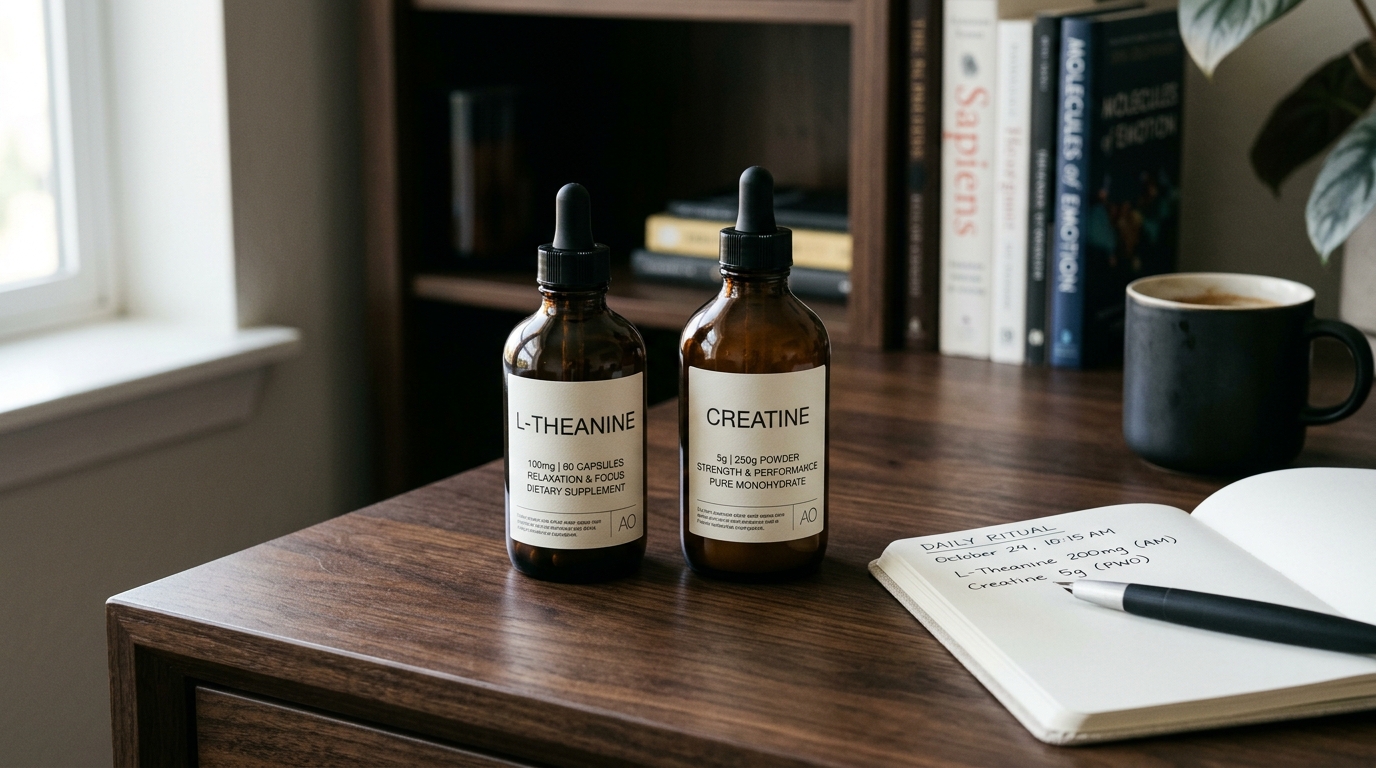
- The 2:1 Synergy: Combining 200mg L-Theanine with 100mg caffeine enhances attentional focus while elevating 8–12 Hz alpha brainwave activity, eliminating sympathetic tremors and anxiety.
- Cortical Phosphocreatine Shuttle: Daily supplementation with 5g Creatine Monohydrate elevates brain phosphocreatine reserves by 8–10%, preserving working memory during sleep debt.
- Acetylcholine Optimization: Citicoline (CDP-Choline) donates both cytidine (for uridine synthesis) and choline (for acetylcholine), driving synaptic membrane turnover and attentional endurance.
1. Beyond the "Limitless" Pill Myth: The True Science of Nootropics
The commercial supplement industry has inundated knowledge workers with proprietary multi-ingredient blends claiming to unlock 100% of brain power. Most of these products contain under-dosed stimulants wrapped in non-transparent "proprietary formulas."
In clinical human performance coaching, we operate on a strictly mechanistic bioenergetic framework. The human brain cannot be chemically forced into infinite output without biological tradeoffs. Instead, genuine cognitive optimization focuses on three measurable biochemical mechanisms:
- ATP Bioenergetics: Enhancing the rate of intracellular high-energy phosphate donation in cortical neurons.
- Neurotransmitter Synthesis Buffering: Supplying dietary rate-limiting precursors for dopamine, acetylcholine, and GABA before depletion occurs.
- Oscillatory Waveform Tuning: Mitigating sympathetic cardiovascular jitter while promoting calm, focused alpha-wave brain states.
2. The Gold Standard Synergy: L-Theanine + Caffeine (The 2:1 Ratio)
Caffeine is the world's most widely consumed psychostimulant. While its adenosine antagonism reliably elevates alertness, high doses trigger peripheral sympathetic side effects: increased peripheral vascular resistance, elevated systolic blood pressure, fine motor tremors, and anxiety.
Enter L-Theanine (gamma-glutamylethylamide), a non-proteinogenic amino acid naturally present in Camellia sinensis (green tea). Structurally analogous to glutamate, L-Theanine crosses the blood-brain barrier via the large neutral amino acid transporter (LAT1). In the central nervous system, L-Theanine:
- Acts as a weak antagonist at ionotropic glutamate receptors (AMPA and kainate), dampening excessive neuronal excitability.
- Stimulates the synthesis and release of inhibitory gamma-aminobutyric acid (GABA).
- Promotes occipital and frontal alpha-band electroencephalographic oscillations (8–12 Hz), the signature electrical state of "relaxed alertness."
Double-blind, placebo-controlled trials (such as Haskell et al., Biological Psychology) demonstrate that co-administering 200mg L-Theanine with 100mg Caffeine (a 2:1 ratio) produces superior cognitive performance compared to caffeine alone: reaction times improve, distraction susceptibility drops by 28%, and caffeine-induced blood pressure elevation is completely prevented.
3. Creatine Monohydrate: The Cerebral Energy Buffer
Historically relegated to bodybuilding locker rooms, Creatine Monohydrate has emerged as one of the most rigorously validated neuro-protective compounds in modern neuroscience.
The brain accounts for approximately 20% of the body's total energy budget. When prefrontal neurons fire continuously during complex algorithmic problem solving, intracellular ATP is rapidly hydrolyzed into ADP. To maintain synaptic transmission, ADP must be immediately re-phosphorylated back into ATP:
ADP + Phosphocreatine ↔ ATP + Free Creatine (via Brain-type Creatine Kinase)
Neurons express high concentrations of cytosolic brain-type creatine kinase (BB-CK). By supplementing with 5 grams of pure creatine monohydrate daily, brain total creatine and phosphocreatine pools increase by 8% to 10% (measured via 31P-Magnetic Resonance Spectroscopy). In human trials under acute sleep deprivation and intense mental calculation, creatine supplementation prevents cognitive decline, preserves working memory, and reduces mental fatigue.
4. Acetylcholine Precursors: Citicoline vs Alpha-GPC
Acetylcholine (ACh) is the primary neuromodulator governing sustained attentional focus, sensory gating, and synaptic plasticity in the hippocampus. When engaged in intensive learning, executive workers burn through endogenous choline reserves.
| Compound | Active Payload & Metabolic Fate | Clinical Application |
|---|---|---|
| Citicoline (CDP-Choline, 250–500mg) | Cleaves into cytidine and free choline; cytidine converts to uridine, which upregulates dopamine receptor density and membrane phosphatidylcholine | Best for daily long-term cognitive endurance, memory consolidation, and neuro-protection |
| Alpha-GPC (300–600mg) | 40% choline by weight; crosses blood-brain barrier rapidly; stimulates acute acetylcholine and growth hormone release | Best for acute pre-workout or intense 90-minute focus sprints; dose 2–3x weekly to avoid tolerance |
5. The Daily Executive Bioenergetic Stack Architecture
Here is the clean, non-habit-forming daily supplementation schedule designed for senior technical professionals:
Frequently Asked Questions: Nootropic Stacking
Why is the 2:1 L-Theanine to Caffeine ratio considered the gold standard?
L-Theanine is an amino acid analog of glutamate that readily crosses the blood-brain barrier. It acts as an antagonist at AMPA and NMDA glutamate receptors while promoting inhibitory GABA and elevating 8–12 Hz alpha brainwave coherence. Pairing 200mg of L-Theanine with 100mg of caffeine blunts peripheral vasoconstriction, prevents cardiovascular jitteriness, and sharpens visual attentional focus beyond either compound alone.
How does creatine monohydrate improve brain performance?
While famous for muscular hypertrophy, creatine is fundamentally a cellular energy shuttle. In neurons and astrocytes, creatine is phosphorylated by brain-type creatine kinase into phosphocreatine. During demanding cognitive tasks or acute sleep deprivation, phosphocreatine donates a high-energy phosphate group to regenerate ATP rapidly, preserving prefrontal working memory and processing speed.
When should L-Tyrosine be included in a cognitive stack?
L-Tyrosine is the direct enzymatic precursor to L-DOPA, dopamine, and norepinephrine. Under acute cognitive stress, sustained attention, or cold exposure, catecholamines deplete rapidly. Supplementing 500mg to 1,000mg of L-Tyrosine 30 minutes before high-intensity focus sessions prevents catecholamine depletion and sustains cognitive flexibility.