Circadian Synchronization Blueprint for Knowledge Workers: Master Melatonin, Cortisol & Deep Sleep Architecture
Why executive cognitive endurance, insulin sensitivity, and emotional resilience depend on aligning molecular clocks in the suprachiasmatic nucleus. An evidence-based masterclass on lux physics, temperature dynamics, and glymphatic clearance.
Core Chronobiological Tenets
- The Master Pacemaker: The Suprachiasmatic Nucleus (SCN) coordinates trillions of peripheral cellular clocks across the liver, pancreas, heart, and skeletal muscle via autonomous transcriptional feedback loops (CLOCK/BMAL1 and PER/CRY).
- The Cortisol-Melatonin Sawtooth: Peak cognitive performance requires an immediate morning Cortisol Awakening Response (CAR) triggered by photon capture, followed by a precipitous decline leading to an uninhibited evening melatonin surge.
- Thermal Thermoregulation: Sleep initiation strictly requires a 1.0°C to 1.5°C drop in internal core body temperature, facilitated by peripheral vasodilation of the hands and feet.
- Glymphatic Cleansing: The macroscopic waste-clearance system of the brain operates almost exclusively during deep slow-wave NREM sleep, clearing neurotoxic metabolites accumulated during intense waking cognition.
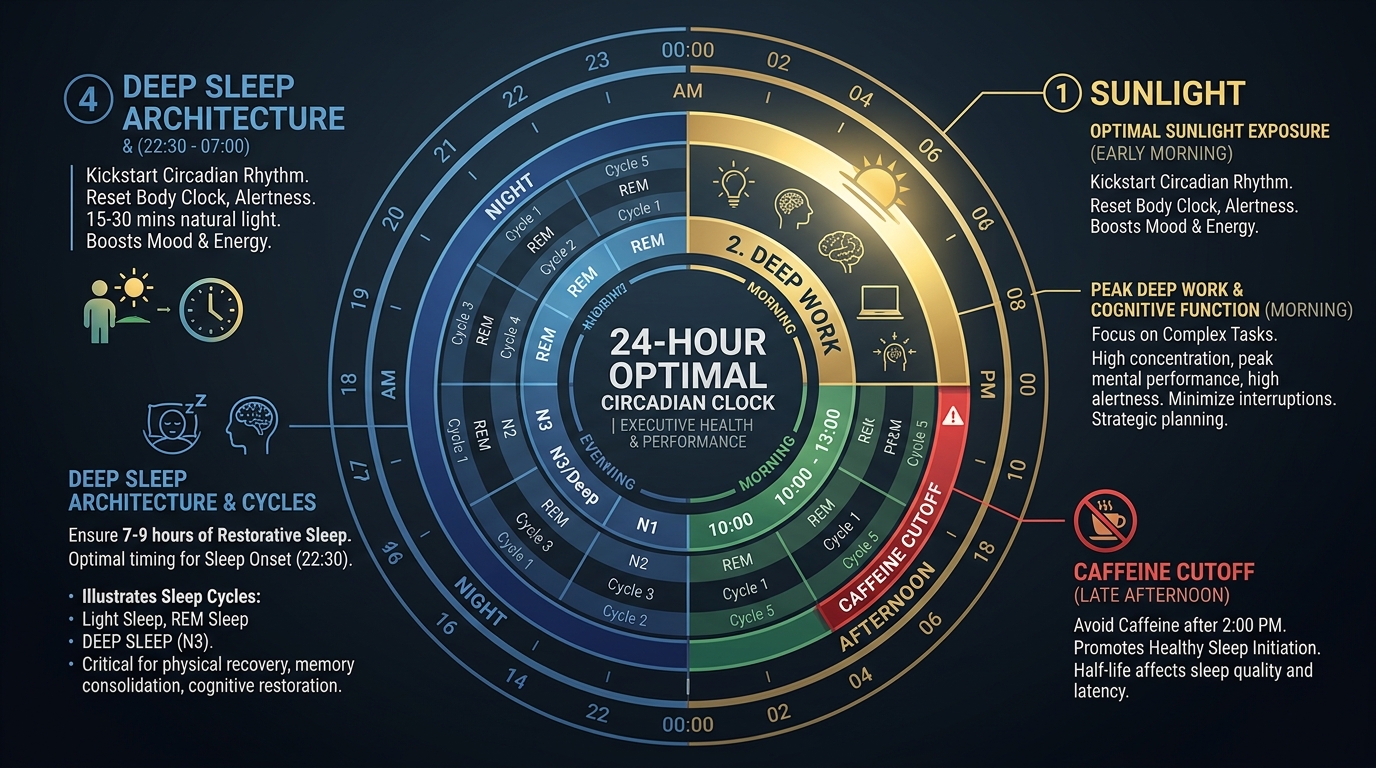
1. The Molecular Architecture of the 24-Hour Clock
Every cell in the human organism contains an autonomous molecular clockwork mechanism. In 2017, the Nobel Prize in Physiology or Medicine was awarded to Jeffrey C. Hall, Michael Rosbash, and Michael W. Young for discovering the molecular gears driving circadian oscillations: the transcriptional-translational feedback loop (TTFL).
In each cell, two transcription factors—CLOCK and BMAL1—bind to promoter elements on DNA, driving the transcription of the Period (PER1, PER2, PER3) and Cryptochrome (CRY1, CRY2) genes. As PER and CRY proteins accumulate in the cytoplasm, they form complexes, translocate back into the nucleus, and directly inhibit their own transcription factors (CLOCK:BMAL1). Over approximately 24 hours, the PER and CRY proteins degrade, releasing the brake and allowing the cycle to repeat.
However, left in total darkness, the human endogenous circadian period averages approximately 24.2 to 24.4 hours. Without daily recalibration, human sleep-wake cycles drift forward by 15 to 30 minutes every single day. This daily recalibration is governed by external time cues known as zeitgebers, with solar light being the supreme regulator.
2. Retinal Photobiology: The ipRGC-SCN Axis
How does the brain know what time of day it is? The answer lies not in our visual rod and cone photoreceptors, but in a specialized subset of neural cells discovered in the early 2000s: intrinsically photosensitive Retinal Ganglion Cells (ipRGCs).
Unlike rods and cones, which adapt rapidly to light to process high-resolution visual imagery, ipRGCs are sluggish, non-image-forming photon integrators. They express the photopigment melanopsin, which exhibits an absorption peak specifically in the blue wavelength spectrum between 460 nm and 480 nm.
| Environment / Light Source | Photon Intensity (Lux) | Biological Impact on SCN Clock |
|---|---|---|
| Direct Outdoor Morning Sunlight | 50,000 – 100,000 Lux | Instant SCN synchronization; immediate CAR activation; sets 14-hour melatonin timer |
| Overcast Morning Cloud Cover | 10,000 – 25,000 Lux | Sufficient photon density for SCN reset (requires 15–20 minutes exposure) |
| Typical Modern Office / Apartment | 300 – 500 Lux | Too dim to anchor morning wakefulness; creates "biological darkness" during day |
| Smartphone / Laptop at Night (30cm) | 100 – 250 Lux (Blue Spectrum) | High melanopsin activation; suppresses pineal melatonin by up to 85% |
When blue-enriched photons strike melanopsin molecules, ipRGCs depolarize and fire action potentials down the retinohypothalamic tract (RHT) directly into the Suprachiasmatic Nucleus (SCN) in the anterior hypothalamus. The SCN immediately signals the adrenal glands to release a healthy pulse of cortisol (the Cortisol Awakening Response), elevating heart rate, core temperature, and cognitive alertness, while simultaneously setting an internal biological timer for melatonin release approximately 14 to 16 hours later.
3. The Cortisol-Melatonin Dynamic: The Sawtooth Wave
In a healthy circadian physiology, cortisol and melatonin maintain a strict inverse relationship:
Morning Phase: Cortisol Dominance
Within 30 minutes of waking, plasma cortisol should spike by 50% to 75% above baseline (the CAR). This surge is essential: it activates immune surveillance, clears nocturnal cytokine accumulation, mobilizes glucose for brain metabolism, and establishes wakefulness. Cortisol should then decline steadily throughout the afternoon and evening.
Evening Phase: Melatonin Dominance
As dusk approaches, dim light allows the pineal gland to begin synthesizing melatonin from serotonin. Melatonin acts as the biochemical herald of darkness, lowering core body temperature, decreasing cerebral blood flow to sensory processing areas, and coordinating sleep onset.
4. Thermoregulation & Sleep Architecture: The Hot Shower Paradox
Light is not the only circadian driver; temperature is an equally powerful zeitgeber. Circadian body temperature follows a robust 24-hour sinusoidal wave: it reaches its minimum (the temperature nadir) approximately 2 hours before habitual wake time, climbs throughout the day to peak in late afternoon, and begins dropping rapidly prior to sleep onset.
To initiate Stage 3 slow-wave sleep, your brain must decrease its internal core temperature by approximately 1.0°C to 1.5°C. If core temperature remains elevated, sleep onset latency increases, and the duration of deep restorative slow-wave sleep is severely truncated.
This biological reality explains the Hot Shower Paradox: taking a hot bath or shower (40°C–42°C) roughly 90 minutes before bed dramatically accelerates sleep onset. The warm water induces intense vasodilation of the blood vessels in your hands, feet, and face (distal skin surfaces). When you step out of the bath, these dilated vascular beds act as heat radiators, dumping internal thermal energy into the surrounding air and triggering a precipitous crash in core body temperature.
5. The Glymphatic System: Nightly Brain Filtration
Why do we sleep? For centuries, scientists believed sleep was simply passive rest. In 2012, Danish neuroscientist Dr. Maiken Nedergaard discovered the glymphatic system—a macroscopic waste-clearance pathway utilizing convective fluid flux through the central nervous system.
During wakefulness, neurons and astrocytes are tightly packed together, creating narrow interstitial spaces that limit fluid flow. However, during deep slow-wave (NREM Stage 3) sleep, the volume of the brain's extracellular interstitial space expands by 60%. Astrocytic end-feet expressing the water channel protein Aquaporin-4 (AQP4) facilitate the pulsatile rushing of cerebrospinal fluid (CSF) through brain tissue, washing away toxic metabolic byproducts accumulated during executive cognition:
- Extracellular Glutamate: Prevents daytime synaptic excitotoxicity.
- Adenosine: Resets homeostatic sleep drive to 0 for morning wakefulness.
- Beta-Amyloid and Hyperphosphorylated Tau: Prevents chronic neurodegenerative aggregations.
- Alpha-Synuclein: Preserves substantia nigra dopaminergic integrity.
6. The Executive Circadian Protocol: 5 Non-Negotiable Anchors
- Morning Lux Exposure (Within 30 Mins): Step outside for 10–15 minutes of direct morning sunlight (or 30 minutes on overcast days). Do not wear sunglasses. This single action establishes your SCN clock and guarantees evening melatonin onset.
- Delay Caffeine Intake 90 Minutes: Allow morning adenosine receptors to clear naturally via cortisol. Ingesting caffeine immediately upon waking creates an afternoon energy crash.
- Circadian Meal Timing: Discontinue solid food consumption at least 3 hours before sleep. Nocturnal digestion elevates core body temperature and forces peripheral liver clocks out of sync with the central SCN.
- Dim Evening Illumination: After 20:00, turn off overhead fluorescent and LED fixtures. Transition exclusively to floor-level amber, red, or low-wattage incandescent light.
- Maintain Bedroom Ambient Coolness: Set your bedroom thermostat between 18°C and 19.5°C (65°F–67°F) to facilitate the nocturnal core temperature drop.
Frequently Asked Questions: Circadian Synchronization
What is the primary zeitgeber for human circadian synchronization?
Solar photon exposure is the dominant primary zeitgeber (time-giver). Photons hitting intrinsically photosensitive retinal ganglion cells (ipRGCs) stimulate the retinohypothalamic tract, synchronizing the suprachiasmatic nucleus (SCN) in the anterior hypothalamus. Secondary zeitgebers include the timing of food ingestion, core body temperature changes, and physical exercise.
How does nocturnal blue light exposure suppress melatonin synthesis?
ipRGCs express the photopigment melanopsin, which is maximally sensitive to blue light wavelengths between 460nm and 480nm. Exposure to even moderate indoor LED or screen lighting (100 to 300 lux) after dusk signals the SCN that it is midday, suppressing pineal melatonin secretion by up to 85% and shifting the circadian phase backward by 90 minutes.
What is the glymphatic system and why is deep sleep necessary for executive function?
The glymphatic system is a glial-dependent waste clearance pathway discovered by Dr. Maiken Nedergaard. During slow-wave (NREM Stage 3) sleep, astrocytic aquaporin-4 (AQP4) channels facilitate the influx of cerebrospinal fluid through the brain parenchyma, washing away metabolic neurotoxins such as beta-amyloid, tau, and accumulated glutamate.