90-Minute Ultradian Rhythm Focus Sprints: The Physiology of the BRAC Cycle
Why forcing four continuous hours of analytical deep work causes cognitive decay, and how syncing your calendar to the 90-minute Basic Rest-Activity Cycle yields twice the output with half the fatigue.
Key Ultradian Findings
- The Kleitman Cycle: The human nervous system oscillates between high-alertness and restorative down-regulation across 90-to-110-minute intervals known as the Basic Rest-Activity Cycle (BRAC).
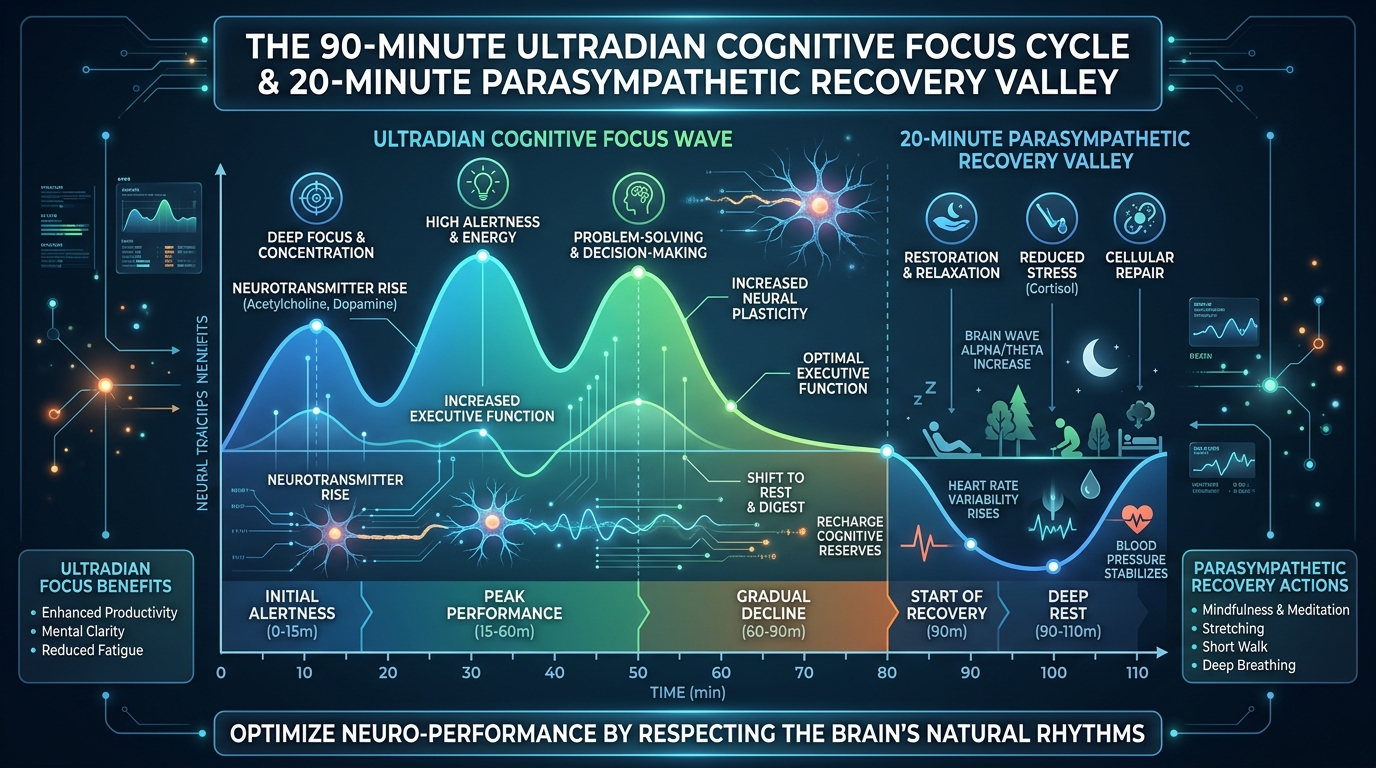
- Brainwave Shifting: During the active crest, prefrontal circuits display coherent 15–30 Hz beta and 40 Hz gamma oscillations. At the trough, power shifts to 8–12 Hz alpha and 4–7 Hz theta frequencies.
- Adrenaline Compensation Hazard: Continuing to work through the biological trough forces the adrenal glands to secrete compensatory cortisol and epinephrine, triggering anxiety and impairing fine analytical judgment.
1. The Discovery of Daytime Ultradian Rhythms
In 1953, University of Chicago physiologist Dr. Nathaniel Kleitman made history by co-discovering Rapid Eye Movement (REM) sleep. While mapping sleep architecture, Kleitman noticed an undeniable rhythmic pattern: human sleep does not progress as an unvarying monophasic continuum, but rather in discrete 90-to-120-minute ultradian cycles between slow-wave non-REM and active REM dreaming states.
Crucially, Kleitman realized that this 90-minute biological clock does not shut down upon waking. In his seminal 1963 paper, he formulated the concept of the Basic Rest-Activity Cycle (BRAC). The human nervous system operates under an inescapable endogenous oscillator that drives alternating 90-minute periods of metabolic, neurological, and hormonal alertness followed by 20-minute periods of physiological trough.
2. Neuro-Electrical Dynamics: The 90-Minute Brainwave Curve
Electroencephalogram (EEG) recordings during deep cognitive work reveal a predictable waveform trajectory across every 90-minute focus block:
Phase 1: Neural Attunement
The frontoparietal attention network suppresses background sensory stimuli. Beta-wave coherence rises gradually. Resist the impulse to check messages during this initial resistance phase.
Phase 2: Peak Gamma Bandwidth
High-frequency 40 Hz gamma synchrony enables rapid logical synthesis, code generation, and deep reading comprehension. Maximum working memory availability.
Phase 3: The Metabolic Trough
Extracellular glutamate accumulates in prefrontal synapses. Alpha waves intrude; eye blinks increase; focus diffuses. This is the physiological cue to stop.
3. The Adrenaline Trap: Why Pushing Through Destroys Quality
What happens when an engineer or executive ignores the 90-minute trough and forces themselves to type for three uninterrupted hours?
Because prefrontal neurons can no longer maintain high-firing synchrony on existing metabolic reserves, the hypothalamus signals the adrenal medulla to release epinephrine (adrenaline) and cortisol. This artificial surge of sympathetic alertness temporarily overcomes the subjective feeling of sleepiness.
However, this adrenal-driven focus is qualitatively inferior. High circulating epinephrine shifts cognitive processing from flexible, creative prefrontal circuits toward rigid, stress-reactive subcortical structures (the amygdala and dorsal striatum). The knowledge worker becomes hyper-focused on trivial details, overlooks systemic architectural errors, and displays acute irritability toward team members. Furthermore, borrowing against tomorrow's adrenal budget guarantees an inescapable late-afternoon crash.
4. The 20-Minute Decompression Protocol: What to Do vs. Avoid
The value of your 90-minute focus sprint is determined by how effectively you execute the subsequent 20-minute recovery trough:
| Prohibited Trough Activities (Destructive) | Prescribed Trough Activities (Restorative) |
|---|---|
| Checking email or Slack threads (generates attentional residue) | Panoramic gaze: look out a window or at the horizon for 3–5 minutes to relax ciliary eye muscles |
| Scrolling short-form video or social feeds (triggers phasic dopamine spikes) | Light ambulation: walk outside without headphones or digital devices |
| Consuming high-glycemic carbohydrates or sugary snacks (destabilizes blood glucose) | Electrolyte rehydration: 500ml water with sodium, potassium, and magnesium |
5. How to Calendar the Ultradian Day: The 3x90 Rule
In our high-performance coaching practice, we instruct technical executives to structure their schedule around the 3x90 Rule:
- Sprint 1 (09:00 – 10:30): The highest-complexity task of the day (architectural design, strategic drafting, complex code).
- Trough 1 (10:30 – 11:00): Complete sensory detachment; physical movement.
- Sprint 2 (11:00 – 12:30): Collaborative deep work, technical design review, or high-stakes 1-on-1 strategy.
- Midday Transition (12:30 – 14:00): Low-glycemic lunch and 20-minute Non-Sleep Deep Rest (NSDR).
- Sprint 3 (14:30 – 16:00): Synthesis, code execution, or documentation before transitioning into administrative tasks.
Frequently Asked Questions: Ultradian Sprints
What is the Basic Rest-Activity Cycle (BRAC)?
The Basic Rest-Activity Cycle (BRAC) was identified in the 1950s by pioneering sleep researcher Nathaniel Kleitman. Kleitman discovered that the same 90-to-120-minute cyclical rhythm observed between REM and non-REM sleep stages continues uninterrupted during waking hours, governing daytime alertness, hormonal output, and cognitive acuity.
Why can't high performers sustain focus for 3 or 4 continuous hours?
Past the 90-minute mark, high-frequency beta and gamma EEG oscillations collapse, and the brain shifts toward slow alpha and theta waveforms. Forcing intellectual concentration through this trough triggers compensatory sympathetic adrenal release (adrenaline and cortisol), increasing syntax and logic errors while creating deep mental exhaustion.
What is the most effective way to spend the 20-minute ultradian trough?
The most effective recovery involves activities with zero prefrontal cognitive demand: panoramic vision gaze (looking at a distant horizon), light walking, hydration, or breathwork. Looking at smartphone screens or social media keeps the prefrontal cortex engaged and fails to clear synaptic metabolites.