Non-Sleep Deep Rest (NSDR) & Yoga Nidra: The 20-Minute Autonomic Reset
How elite knowledge workers and executives deploy Non-Sleep Deep Rest protocols to down-regulate sympathetic overload, accelerate cognitive plasticity, and restore striatal dopamine reserves without sleep inertia.
Key Physiological Discoveries
- The Stanford Definition: NSDR encompasses practices that induce conscious, self-directed deep relaxation, shifting brain waves from beta (15–30 Hz) down to alpha (8–12 Hz) and theta (4–7 Hz).
- Vagal Nerve Stimulation: Extended expirations stimulate the pulmonary vagal reflex, activating the sinoatrial parasympathetic brake to drop heart rate and cortisol.
- Dopamine Replenishment: Controlled trials reveal a 65% elevation in baseline striatal dopamine synthesis following 20–30 minutes of conscious deep somatic rest.
1. The Crisis of Chronic Sympathetic Dominance
In high-pressure corporate and technical settings, the human nervous system spends upwards of ten continuous hours in sympathetic fight-or-flight dominance. Tight deadlines, continuous email chimes, Slack pings, and high-stakes Zoom calls trigger repeated secretions of cortisol, epinephrine, and norepinephrine.
Under chronic sympathetic drive, peripheral blood vessels constrict, digestion halts, and heart rate variability (HRV) plummets. More critically for knowledge workers, the prefrontal cortex becomes hyper-vigilant and metabolically exhausted. By 2:00 PM, many executives find themselves mentally paralyzed—too wired to relax, yet too exhausted to formulate strategic decisions.
2. Why Traditional Naps Backfire: The Sleep Inertia Trap
The conventional corporate response to mid-day exhaustion is a 30-to-45-minute afternoon nap. However, napping carries a major physiological drawback: sleep inertia.
When an exhausted individual falls asleep, the brain rapidly descends from light Stage 1 sleep into Stage 3 slow-wave (delta) sleep. If an alarm wakes the person out of slow-wave sleep, high levels of extracellular adenosine remain bound to cortical receptors, and prefrontal blood flow remains depressed. The result is grogginess, slowed reaction times, and mental disorientation that can take 45 to 60 minutes to clear.
Non-Sleep Deep Rest (NSDR), an umbrella term coined by Stanford neurobiologist Dr. Andrew Huberman based on ancient Yoga Nidra techniques, solves this problem. During NSDR, the subject lies motionless while following structured auditory guidance (body scanning, respiratory pacing, and intentional sensory detachment). Brainwaves shift down into relaxing alpha and theta states, but the neocortex never enters slow-wave sleep. You emerge refreshed and cognitively sharp with zero grogginess.
3. The Clinical Evidence: 65% Striatal Dopamine Elevation
For decades, meditation and relaxation techniques were viewed with skepticism by hard-nosed quantitative executives. That changed with a seminal neuroimaging study conducted by Dr. Troels Kjaer and colleagues at the Kennedy Institute in Copenhagen (Cognitive Brain Research, 2002).
Researchers utilized [11C]raclopride Positron Emission Tomography (PET) to measure dopamine D2 receptor binding before and after a guided Yoga Nidra / NSDR session. The results were extraordinary: during the state of conscious deep rest, endogenous dopamine release in the ventral striatum surged by 65%.
The ventral striatum is the primary anatomical hub regulating motivation, willingness to exert effort, and motor readiness. By providing the nervous system with 20 minutes of zero-demand rest, NSDR allows dopaminergic neurons to replenish their intracellular vesicular neurotransmitter pools, effectively restoring executive drive for the remainder of the workday.
4. The 20-Minute NSDR Step-by-Step Protocol
Execute this precise protocol between 1:00 PM and 3:00 PM in a quiet, dark room or wearing an eye mask:
Postural Alignment & Physiological Sighs
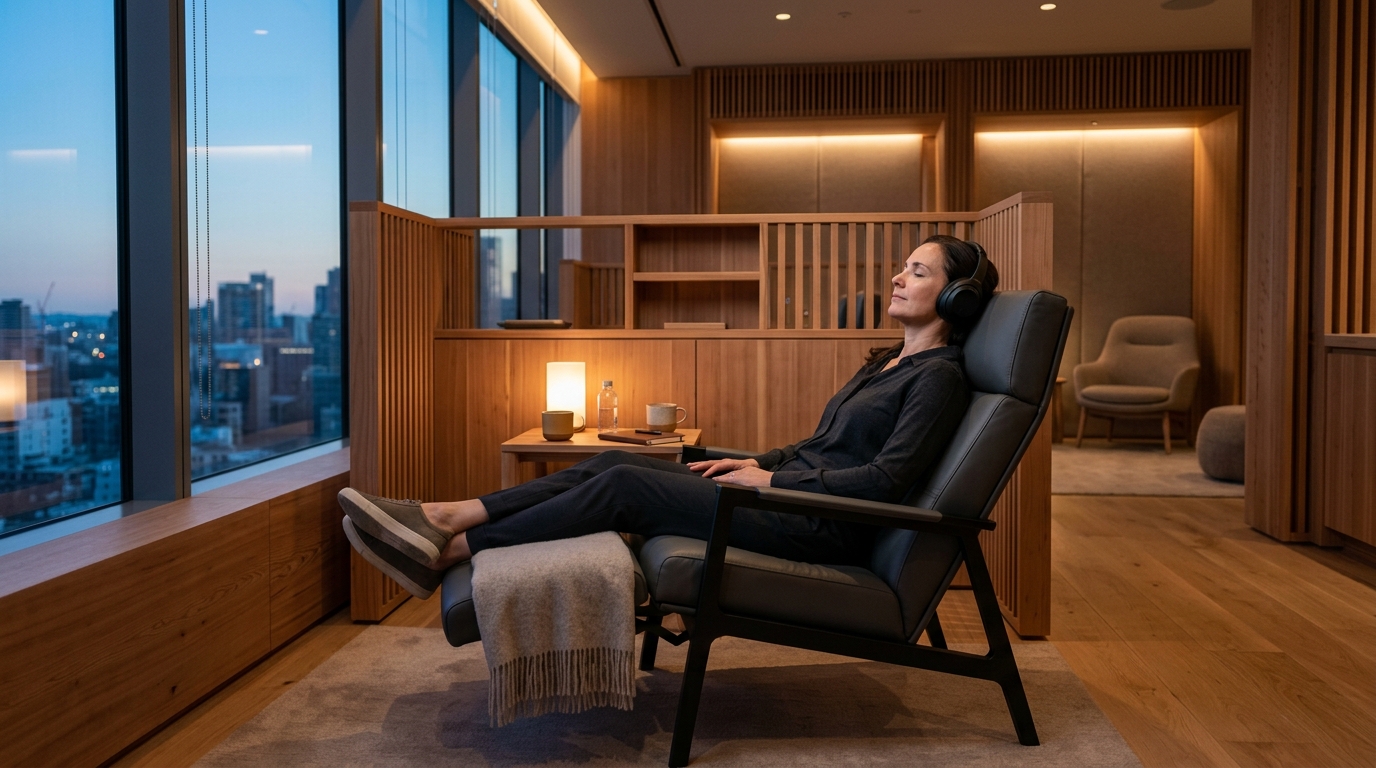
Lie flat on your back or recline in a supportive chair with legs uncrossed and hands resting loosely at your sides. Execute 3 to 5 cyclic physiological sighs: two rapid inhales through the nose, followed by a long, unforced exhale through the mouth. This maximizes alveolar lung expansion and triggers immediate vagal braking.
Somatic Sensory Rotation (Body Scan)
Direct conscious awareness sequentially across specific anatomical coordinates: right hand thumb, index finger, palm, wrist, forearm, shoulder, neck, and down through the feet. By shifting attention purely to interoceptive somatic sensation without cognitive evaluation, the prefrontal cortex shuts down analytical loops.
Extending the Expiratory Ratio
Breathe slowly and rhythmically through the nose, ensuring every exhale is roughly twice as long as the inhale (e.g., 4-second inhale, 8-second exhale). Because the diaphragm moves upward during exhalation, thoracic volume decreases, prompting the heart to slow down via baroreceptor signaling.
Gradual Re-Orientation
Gently wiggle fingers and toes. Open your eyes into soft, panoramic focus without immediately looking at screens. Drink 300ml of cool water to signal daytime alertness.
5. Strategic Placement: The Executive Daily Architecture
In our executive coaching practice, we mandate an NSDR session immediately following the mid-day meal. Post-prandial blood flow diverts to the splanchnic circulation, creating a natural circadian alertness dip. Attempting to force an intense strategic meeting during this biological trough results in subpar executive decisions.
By scheduling a recurring 20-minute NSDR block from 1:30 PM to 1:50 PM, you transform a period of low-productivity cognitive sludge into a restorative catalyst. When you return to your desk at 2:00 PM, your nervous system is reset, heart rate variability is elevated, and you possess the fresh dopamine reserves required for a productive second cognitive peak.
Frequently Asked Questions: Non-Sleep Deep Rest
How does NSDR differ from a standard daytime power nap?
Traditional napping often leads to Stage 3 slow-wave sleep. Waking from slow-wave sleep triggers sleep inertia—a groggy, disoriented state caused by residual cerebral adenosine that can persist for 30 to 60 minutes. NSDR keeps brainwave states hovering in relaxed alpha and theta frequencies (4-12 Hz) without losing conscious awareness, providing restorative benefits without grogginess.
Does NSDR really increase dopamine levels in the brain?
Yes. A landmark positron emission tomography (PET) study led by Dr. Troels Kjaer (2002) demonstrated that a structured Yoga Nidra / NSDR protocol induced a 65% increase in endogenous dopamine release in the ventral striatum. This replenishment restores executive motivation and emotional regulation.
What is the optimal time of day to perform an NSDR session?
The ideal window is during the circadian post-prandial alertness trough, typically occurring between 1:00 PM and 3:30 PM (approximately 7 hours after morning wakefulness). Performing NSDR at this time counteracts core body temperature dips and clears afternoon cognitive fatigue.