Sauna Hyperthermia, Heat Shock Proteins & Cerebral Hemodynamics: The Executive Longevity Shield
Why 20 minutes in a Finnish dry sauna delivers cardiovascular and neuroprotective adaptations equivalent to moderate aerobic exercise, and how molecular chaperone HSP70 preserves long-term executive bandwidth.
Key Physiological Discoveries
- The Kuopio Prospective Findings (PMID: 27932366): Men bathing in a traditional Finnish sauna 4 to 7 times weekly exhibited a 66% risk reduction in all-cause dementia and a 65% reduction in Alzheimer's disease diagnosis over a 20-year follow-up.
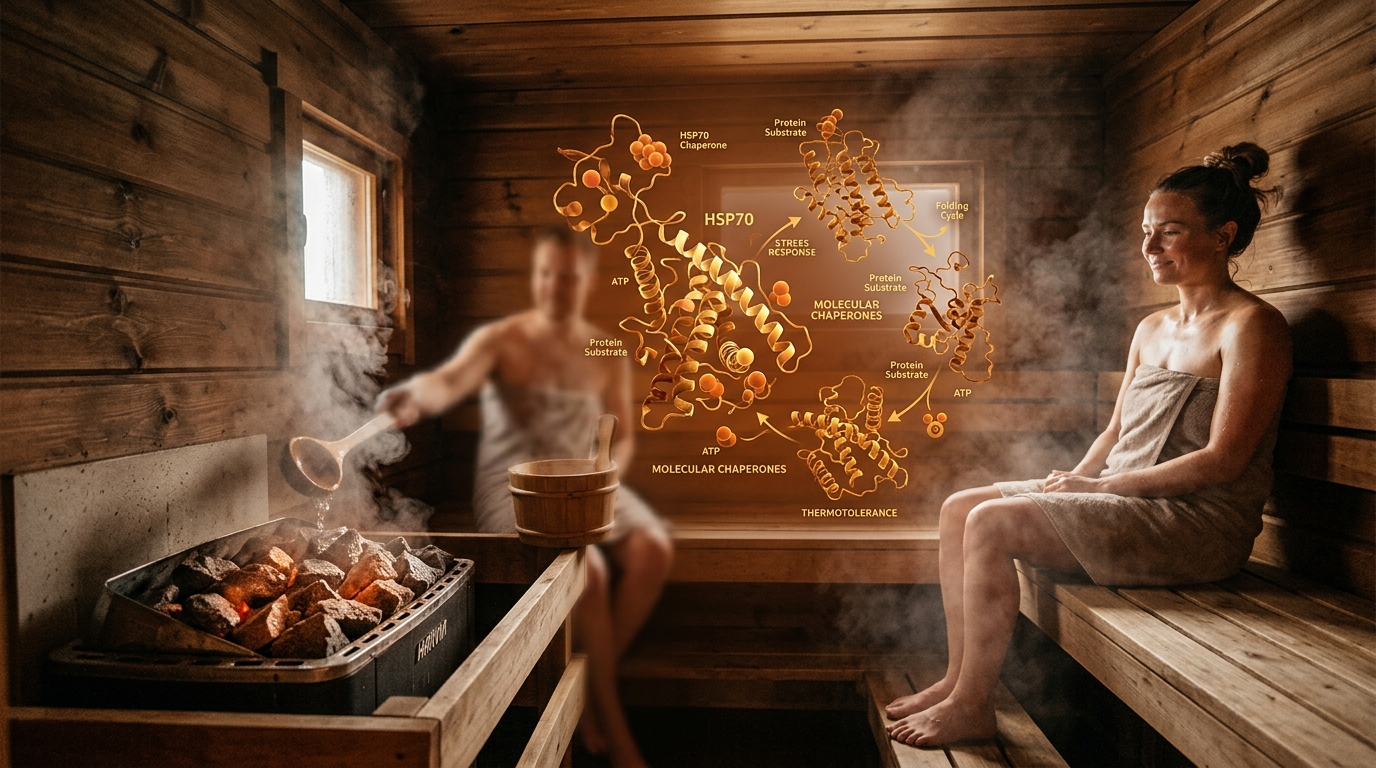
- Molecular Chaperone Induction: Deliberate hyperthermia upregulates Heat Shock Protein 70 (HSP70), preventing neurodegenerative protein misfolding, clearing aggregated protein debris, and stimulating cellular proteostasis.
- Hemodynamic Mimicry: Elevated cutaneous temperature increases cardiac output by 60–70%, elevates endothelial nitric oxide synthase (eNOS), and triggers subsequent core cooling that accelerates sleep onset.
1. Thermal Stress as a Hormetic Amplifier for High Performers
In the relentless pursuit of cognitive performance and long-term executive durability, leaders often view physical recovery as passive rest. Yet biological systems do not adapt to comfort; they adapt to structured, tolerable stressors—a biological principle termed hormesis.
While cold exposure shocks the central nervous system into noradrenergic alertness, deliberate hyperthermia—specifically traditional Finnish dry sauna bathing—initiates a complementary, restorative cellular cleaning cascade. Inside a 175°F to 200°F (80°C to 95°C) cedar sauna, core body temperature climbs toward 101.5°F (38.6°C), mimicking the physiological profile of a moderate-to-vigorous cardiovascular sprint.
For knowledge workers chained to desks for 10 hours daily, this thermal load acts as an executive longevity shield: reducing arterial stiffness, flushing cellular debris via molecular chaperones, and priming slow-wave sleep architecture. Integrating this modality alongside deliberate cold, as detailed in our analysis of cold water immersion neurobiology, provides the ultimate autonomic contrast toolkit.
2. The Laukkanen KIHD Data: The 66% Dementia Risk Reduction
The primary clinical validation of sauna therapy stems from the University of Eastern Finland. Dr. Jari Laukkanen and his epidemiological research team analyzed data from the Kuopio Ischemic Heart Disease Risk Factor Study (KIHD), tracking 2,315 middle-aged men over an average follow-up period of 20.7 years (published in JAMA Internal Medicine and Age and Ageing).
The cohort was stratified based on their weekly sauna habits: 1 session per week (baseline reference), 2 to 3 sessions per week, and 4 to 7 sessions per week. After rigorous adjustments for smoking, socioeconomic status, alcohol consumption, cardiorespiratory fitness, and resting blood pressure, the results demonstrated remarkable dose-dependent neuro-cardiovascular protection:
| Health Outcome | 1 Session / Week | 2–3 Sessions / Week | 4–7 Sessions / Week |
|---|---|---|---|
| All-Cause Dementia Risk | Baseline (1.00) | -22% Risk Reduction | -66% Risk Reduction (HR: 0.34) |
| Alzheimer’s Disease Risk | Baseline (1.00) | -20% Risk Reduction | -65% Risk Reduction (HR: 0.35) |
| Sudden Cardiac Death | Baseline (1.00) | -22% Risk Reduction | -63% Risk Reduction (HR: 0.37) |
| Fatal Cardiovascular Disease | Baseline (1.00) | -27% Risk Reduction | -50% Risk Reduction (HR: 0.50) |
While observational associations cannot definitively establish pure causality, the stark linear dose-response gradient provides robust epidemiological support for incorporating regular thermal bathing into executive health architectures.
3. Molecular Chaperone Dynamics: HSP70 & Proteostasis
At the cellular level, why does heat stress protect the brain? The human brain operates at extreme computational density. Across decades of high-stress knowledge work, neurons accumulate damaged, misfolded proteins due to oxidative phosphorylation byproducts and environmental toxins. If left unchecked, these malformed proteins aggregate into toxic oligomers—such as extracellular amyloid-beta plaques and neurofibrillary tangles of hyperphosphorylated tau—eventually driving synaptic dysfunction and cognitive decline.
Hyperthermia activates a master transcriptional regulator called Heat Shock Factor 1 (HSF1). Under normal conditions, HSF1 is held dormant in the cytoplasm. When ambient heat begins denaturing cellular proteins, HSF1 translocates rapidly to the cell nucleus, binding to heat shock elements and upregulating Heat Shock Proteins (HSPs), specifically HSP70 and HSP90.
HSP70 functions as an ATP-dependent molecular chaperone. It recognizes exposed hydrophobic patches on damaged proteins, physically binds to them, and prevents toxic aggregation. HSP70 either assists the polypeptide chain in refolding into its native, biologically active three-dimensional conformation or shepherds irreversible aggregations directly to the ubiquitin-proteasome and lysosomal autophagic machinery for recycling.
4. Cardiovascular Mimicry & Endothelial Nitric Oxide
During a 20-minute sauna session, the cardiovascular system undergoes significant hemodynamic alterations:
- Heart Rate Acceleration: Resting heart rate climbs from 60 bpm to 120–150 bpm, mimicking the cardiovascular workload of moderate-intensity cycling or jogging.
- Cutaneous Vasodilation & eNOS: Blood flow is diverted heavily to the cutaneous vascular bed to dissipate heat via sweating. Arterial shear stress stimulates endothelial Nitric Oxide Synthase (eNOS), producing systemic nitric oxide and reducing systemic vascular resistance.
- Arterial Compliance: Pulse wave velocity measurements show that regular sauna use decreases arterial stiffness, improving carotid and cerebral microvascular perfusion.
5. The Evening Protocol: Thermal Dynamics & Slow-Wave Delta Sleep
One of the most potent applications of the Finnish sauna for corporate leaders is as an evening sleep-architecture primer. Human circadian biology requires a drop in core body temperature of approximately 1°C to 1.5°C to initiate slow-wave sleep and facilitate pineal melatonin secretion.
When an executive enters a sauna at 8:00 PM, core temperature temporarily spikes. However, upon exiting, the cutaneous blood vessels remain widely dilated. When exposed to cooler ambient air, this vascular network acts like a massive biological heat radiator. Heat rapidly pours out of the extremities, precipitating a precipitous drop in core body temperature within 60 to 90 minutes.
This sharp cooling slope acts as a powerful biological accelerant for Stage 3 Slow-Wave Deep Sleep, multiplying nocturnal delta power and glymphatic brain clearance, perfectly complementing our circadian synchronization protocols.
6. The Executive Sauna Protocol: Temperature, Dosage & Hydration
To replicate the neuro-cardiovascular benefits established in clinical literature without risking dehydration or orthostatic hypotension, follow this evidence-based structure:
- Frequency Target: 3 to 4 sessions per week (ideally advancing to 4–5 as heat tolerance develops).
- Thermal Range: 175°F to 195°F (80°C to 90°C) in a traditional dry wooden sauna with water splashed onto rocks (löyly) to create gentle humidity. Infrared saunas (operating at 130–150°F) require longer sessions (35–45 mins) to induce comparable core temperature elevation.
- Duration: 15 to 20 minutes per session. Exit immediately if dizziness, nausea, or lightheadedness occurs.
- Electrolyte & Fluid Rehydration: During a 20-minute sauna session, the body expels 500ml to 1,000ml of mineral-rich sweat. Consume 750ml of water fortified with 500mg sodium, 200mg potassium, and 100mg magnesium immediately afterward.
- Autonomic Transition: Avoid jarring your nervous system with high-stimulus digital devices after exiting. Instead, pair your post-sauna cooldown with 10 minutes of somatic relaxation, such as NSDR or physiological breathwork.
Frequently Asked Questions: Sauna Hyperthermia & Brain Health
What did the landmark Finnish sauna studies discover regarding neurodegenerative risk?
The landmark Kuopio Ischemic Heart Disease Risk Factor Study (KIHD) led by Dr. Jari Laukkanen followed over 2,300 middle-aged Finnish men for 20 years. Participants using the sauna 4 to 7 times per week demonstrated a 66% lower risk of dementia and a 65% lower risk of Alzheimer's disease compared to once-weekly users.
How do Heat Shock Proteins (HSPs) protect the brain during hyperthermia?
Mild hyperthermia upregulates molecular chaperones, predominantly HSP70 and HSP90. These proteins patrol the intracellular milieu, binding to stressed or misfolded peptide chains, refolding them into functional conformations, and targeting irreversible aggregations—such as amyloid-beta and hyperphosphorylated tau—for autophagic degradation.
Why is an evening sauna session effective for improving sleep architecture?
A sauna session raises core body temperature and causes extensive cutaneous vasodilation. Upon exiting into ambient air, heat rapidly radiates out through dilated peripheral microvasculature, triggering a steep compensatory drop in core body temperature that signals the suprachiasmatic nucleus to facilitate deep slow-wave delta sleep.