Evening Melatonin Suppression: Blue Light, Melanopic Lux Thresholds & Sleep Architecture
Why reading screens or working under overhead LEDs after 8:00 PM obliterates your Dim Light Melatonin Onset (DLMO), and how applying the international CIE S 026 melanopic lux standard preserves restorative slow-wave sleep.
Key Chronobiological Realities
- The Melanopsin Photopigment: The human retina contains specialized non-visual photoreceptors—intrinsically photosensitive retinal ganglion cells (ipRGCs)—with peak sensitivity at 460–480 nm cyan-blue light.
- The PNAS Low-Lux Discovery: Clinical research (PMID: 31110014) proves that even modest indoor illumination between 15 and 30 lux can induce 50% melatonin suppression in photically sensitive knowledge workers.
- The CIE S 026:2018 Standard: Achieving deep restorative sleep requires reducing indoor evening illumination to ≤ 10 melanopic EDI lux during the 3-hour pre-bed window and ≤ 1 melanopic EDI lux in the bedroom.
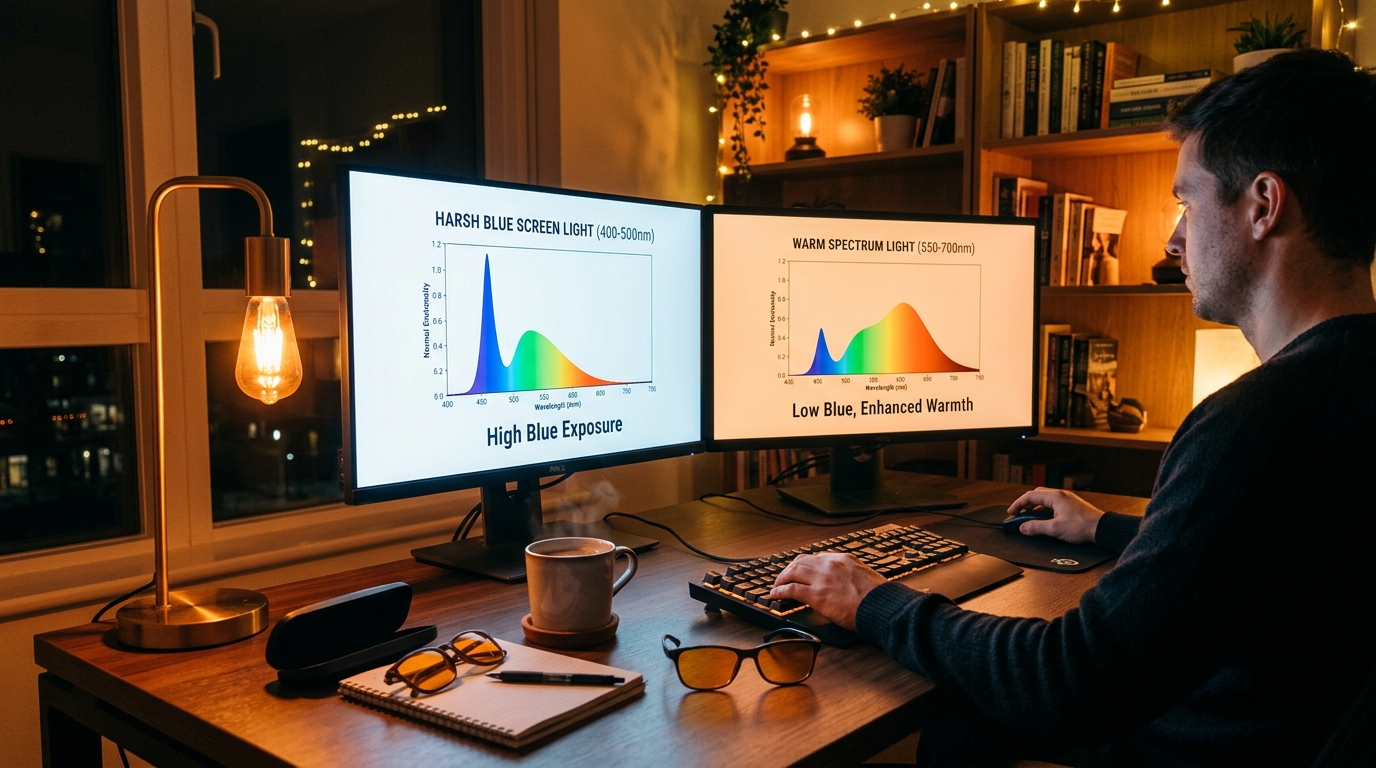
1. The Modern Lighting Paradox: Biologically Daytime at Midnight
For hundreds of thousands of years, human biology operated under an unyielding binary: intense full-spectrum solar irradiance by day (10,000 to 100,000 lux), followed by the near-total darkness of night, punctured only by the flickering warmth of wood fire (under 5 lux, devoid of blue wavelengths). Under this ancestral rhythm, the pineal gland released unhindered pulses of melatonin (N-acetyl-5-methoxytryptamine) approximately two hours before habitual sleep, driving core body temperature down and preparing neural tissues for slow-wave restorative maintenance.
Today, the average executive spends 90% of their day indoors under inadequate daytime illumination (200–400 lux), only to return home and illuminate their living quarters with 4000K recessed LED downlights, 65-inch OLED displays, and ultra-high-density smartphone monitors emitting 150 to 300 lux directly into the retina.
To the suprachiasmatic nucleus (SCN)—the master circadian pacemaker in the anterior hypothalamus—this artificial evening photon flux is indistinguishable from the high-noon sun. The result is chronic, systemic circadian phase delay, delayed Dim Light Melatonin Onset (DLMO), and severe fragmentation of deep delta-wave sleep. Mastering this biological axis requires understanding our overarching circadian synchronization framework.
2. The Phototransduction Machinery: ipRGCs & Melanopsin Kinetics
Until the early 2000s, classical neurobiology assumed that vision and circadian entrainment were governed entirely by retinal rods (scotopic vision) and cones (photopic color vision). The discovery of intrinsically photosensitive retinal ganglion cells (ipRGCs) overturned this paradigm.
Unlike rods and cones, ipRGCs do not form visual images. Instead, they express a primitive photopigment called melanopsin (OPN4). Melanopsin exhibits a distinct absorbance spectrum:
- Peak Spectral Sensitivity: Precisely 460 to 480 nanometers (nm)—the exact wavelength of vibrant sky-blue, which also happens to match the spectral peak emitted by modern white-phosphor LED backlights.
- The Retinohypothalamic Tract (RHT): Axons from ipRGCs bypass the visual cortex entirely. Instead, they project monosynaptically via the RHT directly to the SCN, releasing glutamate and pituitary adenylate cyclase-activating polypeptide (PACAP).
- The Pineal Shutoff: Activation of the SCN sends an inhibitory GABAergic signal through the paraventricular nucleus (PVN) and superior cervical ganglion (SCG), instantaneously halting norepinephrine release at the pineal gland. Enzymatic conversion of serotonin into melatonin by aralkylamine N-acetyltransferase (AANAT) is arrested within minutes.
3. The Dose-Response Reality: Why "Just 20 Minutes of Email" Destroys DLMO
Many executives rationalize evening screen work by believing that moderate room light is harmless compared to direct sunlight. Groundbreaking photobiology research has dismantled this assumption.
A landmark clinical trial published in PNAS (PMID: 31110014) evaluated the dose-response sensitivity of human melatonin suppression to evening room light across a broad demographic cohort. The researchers uncovered startling realities:
- Massive Inter-Individual Variability: Humans vary by more than 50-fold in their ocular sensitivity to evening light. While some resilient individuals require 100 lux to suppress melatonin, others experience 50% melatonin suppression at less than 15 to 30 lux.
- The iPad vs. Print Study (Chang et al., Harvard Medical School): Subjects reading an e-reader or tablet at maximum brightness for 4 hours before bedtime exhibited a 55% suppression of salivary melatonin, delayed DLMO by over 90 minutes, suffered reduced REM sleep percentage, and reported significant morning grogginess despite identical total time in bed.
When you expose your retinas to 100 lux of blue-enriched photons at 9:30 PM, your pineal gland fails to initiate the biological nighttime. Even if you fall asleep out of sheer adenosine exhaustion, your body temperature remains elevated, heart rate variability (HRV) fails to rebound, and Stage 3 Slow-Wave Deep Sleep is suppressed by up to 30%. This sleep fragmentation is exacerbated if caffeine clearance has been compromised earlier in the day, as examined in our analysis of the 90-minute caffeine delay protocol.
4. The International Standard: CIE S 026 & Melanopic EDI
Traditional lighting metrics rely on photopic lux, a mathematical weighting based on the visual sensitivity of human foveal green and red cones (V(λ) function, peaking at 555 nm). Photopic lux is completely inadequate for assessing circadian impact because it severely underestimates the biological potency of short-wavelength blue light.
In 2018, the International Commission on Illumination released CIE S 026:2018, establishing Melanopic Equivalent Daylight Illuminance (melanopic EDI) as the global scientific standard for human-centric lighting:
| Circadian Phase | CIE S 026 Recommendation | Biological Objective | Typical Modern Reality |
|---|---|---|---|
| Daytime (Waking to 5:00 PM) | ≥ 250 melanopic EDI lux | Robust SCN synchronization; peak daytime alertness; elevated mood | 50–150 lux (Sub-optimal indoor office gloom) |
| Evening (3 Hours Prior to Bed) | ≤ 10 melanopic EDI lux | Permits unhindered DLMO; natural drop in core body temperature | 100–300 lux (Overhead LEDs, monitors, smartphones) |
| Sleep Window (Bedtime to Waking) | ≤ 1 melanopic EDI lux | Deep slow-wave sleep; uninterrupted glymphatic brain clearance | 2–10 lux (Streetlights through blinds, standby LEDs) |
To achieve the daytime threshold of ≥ 250 melanopic EDI lux naturally, knowledge workers should prioritize early morning outdoor sunlight, as detailed in our guide to morning lux photon capture and SCN anchoring.
5. The Technology Deconstruction: Amber Glasses vs. Software Filters
To mitigate evening light toxicity, executives often turn to software tools like Apple Night Shift or f.lux. While these tools alter screen chromaticity, optical laboratory testing reveals critical limitations:
Night Shift / f.lux Alone
Reduces the relative ratio of 460 nm photons by roughly 30% to 50%, but does not reduce ocular irradiance. At typical monitor brightness and proximity, the absolute photon flux remains well above the 10 melanopic EDI lux threshold. Helpful, but insufficient as an isolated intervention.
Amber 500nm Lenses (e.g. Spectra479 / TrueDark)
Physical amber/red lenses with an absolute cutoff below 500 nm eliminate 99.8% of melanopsin-activating photons from all ambient light sources simultaneously—including overhead ceiling fixtures, bathroom downlights, and refrigerator door LEDs.
6. The Executive Evening Photobiology Protocol
To enforce strict compliance with the CIE S 026 standard without abandoning evening productivity, execute this 3-step environmental architecture:
- Sunset Light Level Transition (8:00 PM Hard Shift): Extinguish all overhead ceiling cans and recessed LEDs. Switch entirely to low-angle floor lamps utilizing warm incandescent or warm LED bulbs rated at ≤ 2200 Kelvin (or red filament bulbs). Positioning lights below eye level minimizes stimulation of the inferior retina, where ipRGCs are most concentrated.
- Display Dimming & Monochromatic Mode: Reduce external monitor luminance to 10–15% brightness. On iOS or macOS, configure color filters to an intense red tint or activate grayscale mode to remove visual dopaminergic hyper-salience.
- Amber Lens Enforcement (2 Hours Pre-Sleep): Put on certified amber-tinted blue-blocking glasses that block 100% of light between 400 and 500 nm. Maintain wear until sleep masks or total bedroom blackout are engaged.
Frequently Asked Questions: Evening Melatonin & Lux Thresholds
How little evening light is required to suppress endogenous melatonin?
Research published in PNAS reveals extreme inter-individual sensitivity: in susceptible individuals, as little as 5 to 30 lux of room light can produce 50% melatonin suppression. Standard residential overhead lighting (100 to 300 lux) suppresses Dim Light Melatonin Onset (DLMO) by up to 85% and shifts sleep architecture by over 90 minutes.
Why is Apple Night Shift or f.lux insufficient on its own?
Software filters shift screen chromaticity toward warmer spectrums, reducing blue wavelengths around 460–480 nm. However, they do not reduce overall ocular photon irradiance. High visual brightness, screen proximity to the eyes, and long exposure durations still activate melanopsin photopigments, necessitating physical amber lenses and reduced luminance.
What is the CIE S 026 standard for evening melanopic illuminance?
The international CIE S 026:2018 standard recommends that melanopic Equivalent Daylight Illuminance (EDI) be kept under 10 melanopic EDI lux during the 3 hours immediately preceding bedtime, and under 1 melanopic EDI lux during the sleep window.