Cold Water Immersion: The Neurobiology of Prolonged Norepinephrine & Dopamine Elevation
How brief acute thermal stress drives a 530% surge in noradrenaline, establishes a durable 250% dopamine plateau, and primes the executive prefrontal cortex for sustained analytical stamina.
Key Neurochemical Discoveries
- The Šrámek Landmark Data (PMID: 10751106): Immersing in 14°C (57°F) water triggers a 530% increase in plasma norepinephrine and a 250% elevation in circulating dopamine, sustained across several hours without an acute drop.
- The Locus Coeruleus Switch: Cutaneous cold thermal nociceptors activate the brainstem's primary noradrenergic arousal center, converting physical discomfort into heightened vigilance and cognitive clarity.
- The Søberg Principle: Forcing the body to rewarm endogenously through shivering and brown adipose tissue (BAT) non-shivering thermogenesis maximizes mitochondrial uncoupling protein-1 (UCP1) activation and sustained metabolic arousal.
1. Beyond the Social Media Hype: The Neurochemistry of Deliberate Cold
In the modern technological landscape, deliberate cold exposure has transitioned from a fringe Scandinavian tradition and athletic recovery modality into a ubiquitous executive ritual. Silicon Valley founders, venture capitalists, and hedge fund portfolio managers routinely begin their dawn routines submerged in near-freezing water. Yet behind the aesthetic wellness videos lies a profound neurochemical phenomenon that directly influences executive focus and motivational drive.
Knowledge work in high-stakes environments suffers from an epidemic of chronic dopaminergic depletion. Driven by endless asynchronous message pings, digital context switching, and reliance on synthetic stimulants, the executive nervous system frequently slips into low-energy executive apathy.
Cold water immersion (CWI) serves as an acute, non-pharmacological hormetic reset. When engineered with clinical precision, it triggers an endogenous neuroendocrine cascade that fundamentally reorganizes central arousal networks. Understanding how this fits within our broader framework of executive neuro-performance architecture allows leaders to harness thermal stress as a cognitive lever.
2. The Šrámek Landmark Trial: Dissecting the 250% Dopamine Plateau
The primary empirical bedrock for cold-induced neurotransmitter elevation stems from a rigorous clinical investigation conducted by Dr. Petr Šrámek and colleagues at Charles University, published in the European Journal of Applied Physiology (PMID: 10751106).
Healthy human subjects underwent head-out immersion in water maintained at three distinct temperatures: 32°C (thermoneutral), 20°C (cool), and 14°C (cold). While thermoneutral immersion produced negligible neuroendocrine shifts, immersion in 14°C (57°F) water for 60 minutes elicited extraordinary physiological adaptations:
- Plasma Norepinephrine (Noradrenaline): Increased by an astounding 530% above baseline.
- Plasma Dopamine: Elevated by 250% above baseline.
- Plasma Cortisol: Paradoxically decreased or remained stable in cold-adapted conditions, demonstrating that cold shock can dissociate sympathetic arousal from destructive systemic glucocorticoid elevation.
- Metabolic Rate: Elevated by 350% due to active non-shivering and shivering thermogenesis.
Crucially, the kinetics of cold-induced dopamine elevation differ radically from pharmacological dopaminergics (such as Adderall, modafinil, or nicotine). Synthetic stimulants trigger sharp, unphysiological spikes in synaptic dopamine that last 90 minutes, followed by profound vesicular depletion and receptor downregulation—the classic crash. Cold water immersion, by contrast, establishes a prolonged, steady plateau that decays slowly over 2 to 4 hours, mirroring natural motivational drive. This distinction is critical for leaders implementing dopamine resensitization protocols.
| Stimulus | Peak Dopamine Elevation | Kinetic Curve Profile | Subsequent Receptor Impact |
|---|---|---|---|
| Deliberate Cold Immersion (14°C) | +250% (Steady Rise) | Smooth 2–4 hour plateau; zero crash | Preserves baseline D2/D3 sensitivity; stimulates neurogenesis |
| Nicotine | +200% (Instant) | Sharp spike; steep crash within 45 mins | Rapid desensitization of alpha-4 beta-2 nicotinic receptors |
| Amphetamine Derivatives | +500% to +1,000% | Extreme spike; prolonged depressive crash | Vesicular monoamine depletion; severe tonic baseline drop |
3. The Locus Coeruleus & Prefrontal Top-Down Control
What occurs in the brain during the first 10 seconds of entering a cold plunge? The sudden thermal drop is detected by transient receptor potential melastatin 8 (TRPM8) ion channels situated on cutaneous sensory nerves.
These peripheral sensors transmit urgent afferent signals through the spinothalamic tract directly into the locus coeruleus (LC) in the rostral pons. The locus coeruleus is the principal site for brain norepinephrine synthesis. In response to cold shock, the LC fires bursts of noradrenaline that innervate the thalamus, amygdala, and prefrontal cortex.
This massive noradrenergic discharge initiates the primitive "gasp reflex" and tachycardia. Herein lies the executive cognitive training opportunity: by actively overriding panic using paced diaphragmatic exhalations, the prefrontal cortex exerts top-down GABAergic inhibition over the hyperactive amygdala. Surviving this acute thermal threat recalibrates your subjective threshold for corporate stress, fostering unshakable emotional poise under pressure.
4. The Søberg Principle & Brown Adipose Activation
Dr. Susanna Søberg's research on winter swimmers at the University of Copenhagen elucidated the critical distinction between passive versus active thermal recovery:
The Søberg Principle: End on Cold
To maximize metabolic and neuroendocrine adaptations, always end your contrast therapy on cold. Stepping directly from a cold plunge into a hot sauna or under a steaming shower short-circuits the body's natural rewarming machinery.
When you step out of cold water and allow your body to warm naturally through ambient room temperature, your autonomic nervous system recruits Brown Adipose Tissue (BAT) located around the cervical, clavicular, and thoracic spine. Sympathetic noradrenaline binds to beta-3 adrenergic receptors on brown adipocytes, upregulating Uncoupling Protein-1 (UCP1) in the inner mitochondrial membrane. This uncouples oxidative phosphorylation, forcing mitochondria to burn glucose and fatty acids solely to generate heat, sustaining systemic alertness for hours.
5. The Executive Cold Plunge Protocol: Timing & Dosage
For knowledge workers seeking razor-sharp cognitive execution rather than athletic hypothermia endurance, adhere to this precise protocol:
- Cumulative Weekly Dose: 11 total minutes per week. Divide this into 3 sessions of 3.5 minutes, or 4 sessions of 2.5 to 3 minutes. Research demonstrates that surpassing 11 minutes yields diminishing returns for catecholamine modulation.
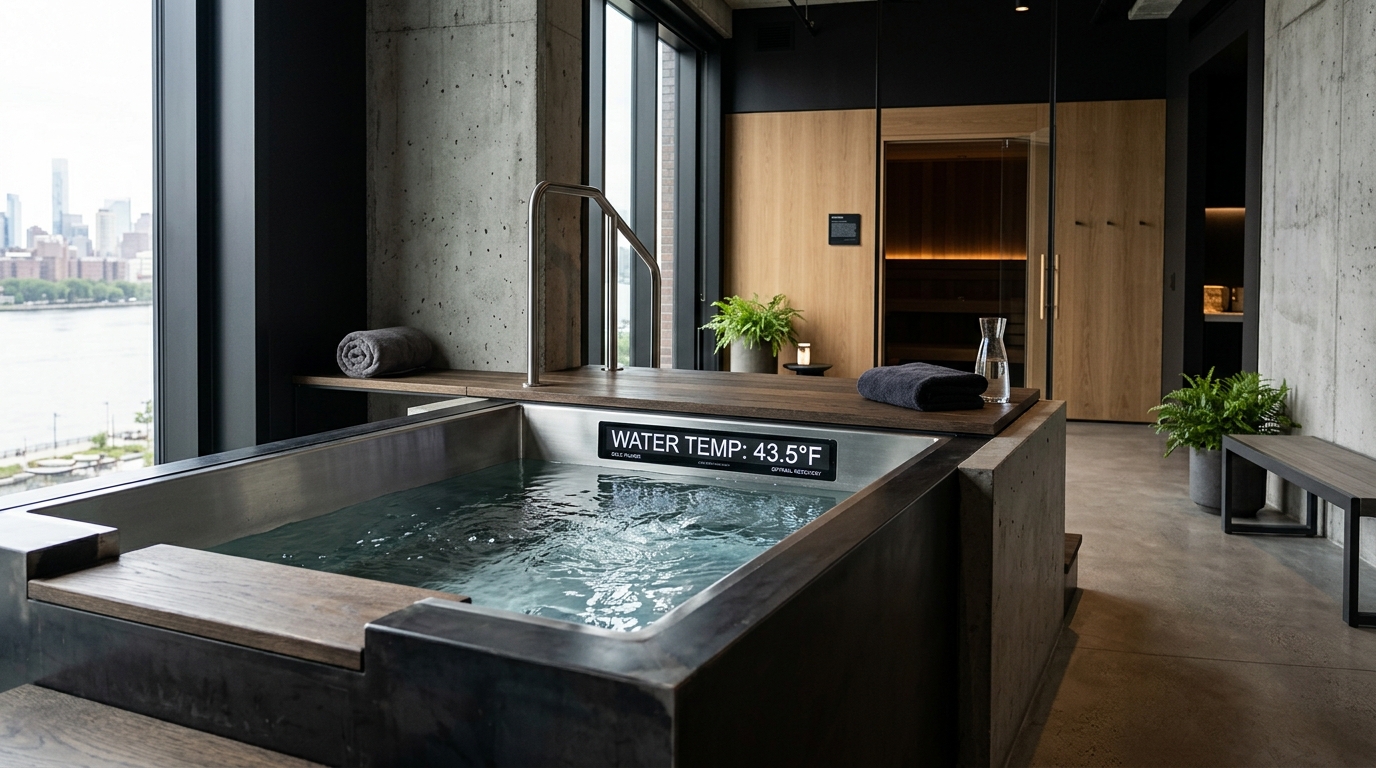
- Temperature Threshold: 50°F to 59°F (10°C to 15°C). The water should feel uncomfortably cold and demand mental courage to enter, but remain completely safe to stay submerged for 2 to 3 minutes.
- Submersion Depth: Submerge up to the neck. Immersing the clavicular fossa stimulates the highest density of cutaneous thermoreceptors.
- Breathing Modulation: Control the initial 15-second hyperventilatory gasp by doubling the length of your exhalations (4 seconds in, 8 seconds out).
- Post-Cold Cognitive Window: After air-drying and dressing in warm layers, take advantage of the 2-hour post-plunge dopaminergic plateau to complete your highest-priority analytical deep work sprint.
Crucial Training Caveat: Muscle Hypertrophy Interference
Cold water immersion within 4 to 6 hours after heavy resistance training suppresses muscle protein synthesis, blunting mTORC1 activation and satellite cell proliferation. If your routine combines strength training with cognitive deep work, perform cold plunges in the morning prior to cognitive work, or on dedicated non-lifting recovery days. On high-strain days when autonomic recovery is depleted, consider substituting cold with Non-Sleep Deep Rest (NSDR).
Frequently Asked Questions: Cold Water Immersion & Neurobiology
How does cold water immersion elevate dopamine without a subsequent crash?
Pharmacological stimulants trigger massive, abrupt vesicular dopamine exocytosis, which depletes intracellular neurotransmitter pools and downregulates D2 receptors, provoking a severe post-stimulant crash. In contrast, cold water immersion activates peripheral and central sympathetic pathways gradually, elevating dopamine by up to 250% across a prolonged multi-hour plateau.
What is the optimal water temperature and weekly duration for cognitive focus?
Research indicates an effective range between 50°F and 59°F (10°C to 15°C). For cognitive enhancement, an accumulated total of 11 minutes per week, divided across 2 to 4 sessions of 2 to 4 minutes each, provides robust catecholaminergic activation without inducing excessive physical shivering or afterdrop fatigue.
Should cold plunging be performed before or after strength training?
Cold water immersion within 4 to 6 hours after hypertrophic resistance training blunts anabolic intracellular signaling pathways (mTORC1 and satellite cell proliferation). However, for executive cognitive deep work, a brief morning cold plunge before analytical work provides clean noradrenergic focus.