Magnesium L-Threonate: Blood-Brain Barrier Penetration, Synaptic Density & Sleep Architecture
Why standard oral magnesium fails to elevate brain concentrations, and how the novel L-threonate chelate crosses the blood-brain barrier to upregulate NR2B receptors, enhance working memory, and deepen slow-wave delta sleep.
Key Neuropharmacological Discoveries
- The MIT Landmark Trial (PMID: 20114284): Dr. Inna Slutsky, Dr. Guosong Liu, and MIT colleagues proved that Magnesium L-Threonate (MgT) elevates cerebrospinal fluid magnesium, increasing functional synaptic density in the prefrontal cortex and hippocampus.
- The NR2B Subunit Upregulation: Raising neuronal magnesium increases NR2B-containing NMDA receptor expression by ~60%, amplifying CaMKII signaling and enhancing Long-Term Potentiation (LTP) magnitude by 52%.
- Direct Sleep Architecture Enhancement: A 2024 double-blind randomized controlled trial utilizing biometric Oura Ring data demonstrated that 1,500–2,000 mg MgT significantly elevates deep slow-wave sleep scores and morning executive alertness.
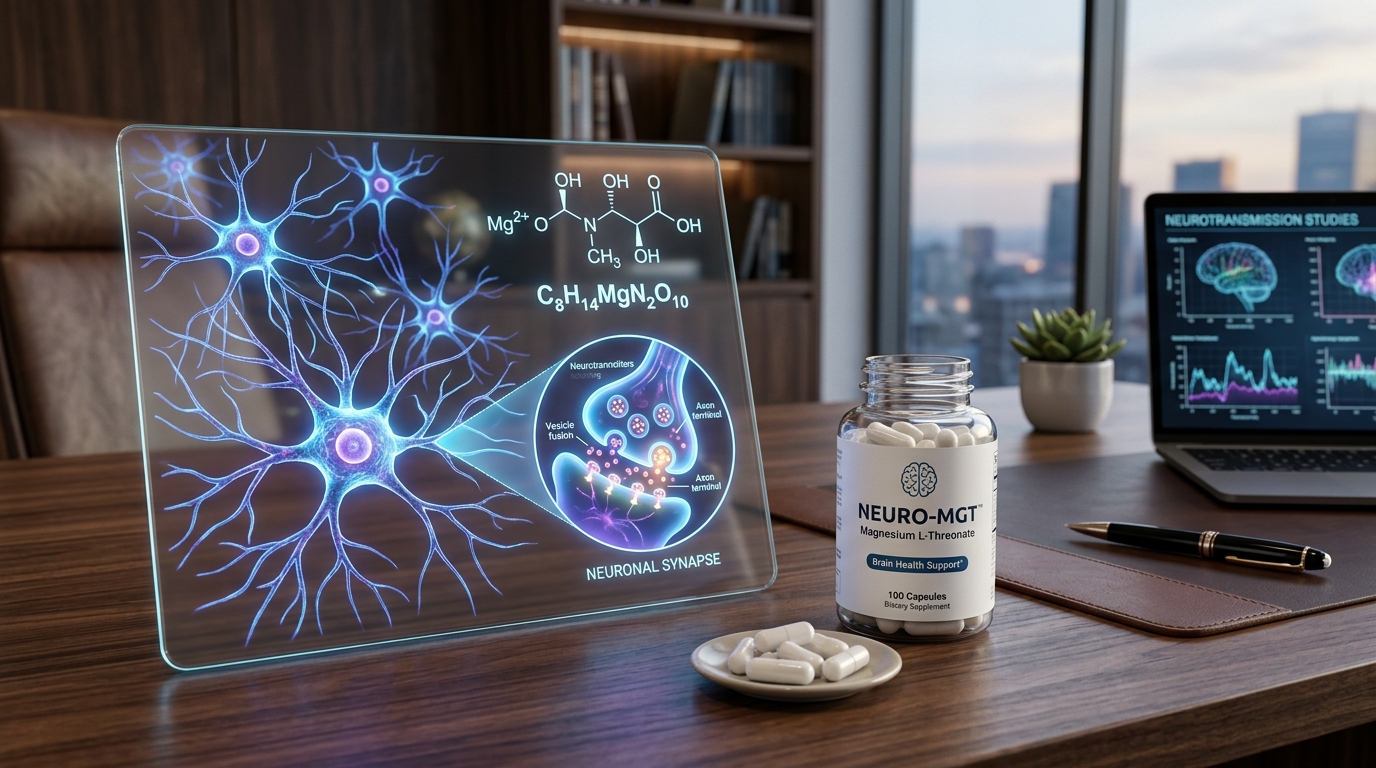
1. The Blood-Brain Barrier Bottleneck: The Mineral Dilemma
Magnesium is the fourth most abundant mineral in the human body, acting as an essential enzymatic cofactor for more than 300 biochemical reactions—including every step of cellular ATP hydrolysis. For knowledge workers managing high cognitive demands, adequate magnesium status is fundamental to maintaining mitochondrial bioenergetics and neurotransmitter synthesis.
Consequently, health-conscious executives routinely supplement with popular magnesium forms: magnesium oxide, citrate, malate, or bisglycinate. While these compounds raise serum magnesium and alleviate peripheral muscular tension or nocturnal leg cramps, they share a critical pharmacological flaw: virtually none of that magnesium crosses the blood-brain barrier (BBB) into the central nervous system.
The brain maintains strict homeostatic control over its internal ionic environment. Cerebral capillary endothelial cells, interconnected by high-resistance tight junctions, strictly regulate magnesium transport. Even when intravenous magnesium sulfate infusions elevate serum magnesium by 300%, cerebrospinal fluid (CSF) magnesium climbs by a meager 10% to 15%, because active extrusion pumps rapidly eject excess ions back into systemic circulation.
To fundamentally alter neural plasticity, cognitive speed, and nocturnal sleep architecture, the mineral must be delivered via a specialized chemical carrier. Understanding this targeted compound is an essential pillar within our broader work on nootropic stacking and bioenergetics.
2. The Slutsky & Liu MIT Trial: Elevating Cerebrospinal Magnesium
In 2010, a team of neuroscientists at the Massachusetts Institute of Technology (MIT) and Tsinghua University, led by Dr. Inna Slutsky and Dr. Guosong Liu, set out to design a magnesium compound specifically engineered to cross the BBB. Their findings were published in the landmark journal Neuron (PMID: 20114284): "Enhancement of Learning and Memory by Elevating Brain Magnesium."
The researchers synthesized Magnesium L-Threonate (MgT, commercially patented as Magtein), chelating magnesium to L-threonate—a natural metabolite of vitamin C. The results dismantled prevailing neurological dogma:
- Cerebrospinal Fluid Penetration: Oral administration of MgT yielded significant, sustained increases in CSF magnesium concentrations (climbing 7% to 15% in rats and over 31% in mice). Conventional magnesium chloride, citrate, and glycinate failed to alter CSF levels at matched doses.
- Synaptic Density Proliferation: Elevating brain magnesium triggered structural remodeling: synaptic puncta density increased by ~30% in the CA1 and dentate gyrus regions of the hippocampus, as well as the infralimbic prefrontal cortex (IL-PFC).
- Enhanced Synaptic Plasticity: Hippocampal brain slices demonstrated a 52% amplification in Long-Term Potentiation (LTP), the cellular foundation of memory consolidation and rapid skill acquisition.
- Cognitive Enhancement: Both young and aged rodents demonstrated significant improvements in working memory, pattern recognition, and flexible rule-shifting during spatial navigation tasks.
3. The Pharmacological Comparison: MgT vs. Common Magnesium Salts
To select the appropriate mineral tool for executive performance, one must understand how different chemical chelates partition between peripheral tissues and the brain:
| Magnesium Salt | Elemental Mg Yield | BBB Permeability & CSF Impact | Primary Physiological Target |
|---|---|---|---|
| Magnesium L-Threonate (Magtein) | ~7.2% (144 mg per 2,000 mg) | Exceptional; elevates CSF magnesium by 7–15%+ | Neuro-Cognitive: Synaptic density, working memory, slow-wave sleep |
| Magnesium Bisglycinate | ~14.1% (140 mg per 1,000 mg) | Negligible direct Mg CSF change; glycine crosses BBB | Somatic relaxation, muscle recovery, peripheral GABA support |
| Magnesium Citrate | ~16.0% (160 mg per 1,000 mg) | Extremely low CSF penetration; systemic elevation only | General systemic deficiency; gastrointestinal motility |
| Magnesium Oxide | ~60.3% (600 mg per 1,000 mg) | Near zero (poor 4% systemic bioavailability) | Osmotic laxative for acute constipation |
While Magnesium Glycinate remains an exceptional, cost-effective compound for relaxing peripheral muscular tone, Magnesium L-Threonate is the only form engineered to alter central synaptic architecture.
4. NMDA Receptor Dynamics: The Voltage-Dependent Magnesium Plug
At the biophysical level, how does elevated brain magnesium enhance focus and learning while calming an overstimulated executive mind? The mechanism centers on the N-methyl-D-aspartate (NMDA) glutamate receptor.
Under normal resting membrane potential (-70 mV), an ionized magnesium molecule (Mg²⁺) sits lodged inside the outer pore of the NMDA channel like a physical cork. When ambient extracellular glutamate drifts by, the magnesium plug prevents premature opening:
- Excitotoxicity Prevention: Chronic stress, digital context switching, and sleep deprivation cause low-grade synaptic glutamate leaking. Without adequate intraneuronal magnesium, this ambient glutamate permits a slow, toxic trickle of calcium (Ca²⁺) into neurons, generating reactive oxygen species, degrading dendritic spines, and producing mental fatigue. The Mg²⁺ plug completely silences this background noise.
- High-Fidelity Depolarization (LTP): When you engage in deliberate analytical deep work, high-frequency presynaptic firing strongly depolarizes the postsynaptic membrane (-30 mV). This electropositive shift physically expels the positively charged Mg²⁺ plug out of the channel pore.
- NR2B Subunit Upregulation: Chronic MgT administration specifically upregulates the NR2B subunit of NMDA receptors by ~60% in the hippocampus (PMID: 20114284). NR2B-containing channels exhibit prolonged opening times, allowing sharp, high-volume calcium influx that activates CaMKII (calmodulin-dependent protein kinase II) by 92%, permanently strengthening the synaptic connection.
This dynamic establishes an immaculate signal-to-noise ratio: silencing distractive synaptic noise while magnifying meaningful high-priority learning. Protecting this prefrontal capacity is central to executive neuro-performance architecture.
5. Sleep Architecture & Stage 3 Slow-Wave Delta Enhancement
Beyond working memory, Magnesium L-Threonate is an exceptional primer for restorative slow-wave sleep. In 2024, a double-blind, randomized, placebo-controlled human clinical trial evaluated 80 adults suffering from sleep complaints using multi-sensor Oura Ring biometrics (PMID: 39645073):
- Slow-Wave Deep Sleep (Stage 3): Participants receiving 2,000 mg of Magtein demonstrated significant, measurable increases in deep sleep duration and delta-wave power compared to placebo.
- REM Sleep Stabilization: REM sleep efficiency improved without the vivid nightmares or groggy morning hangover frequently caused by exogenous melatonin.
- Next-Day Cognitive Readiness: Objective daytime performance scores showed marked reductions in morning sleep inertia and heightened executive alertness.
Mechanistically, brain magnesium potentiates GABA-A receptors, hyperpolarizing thalamocortical relay neurons and facilitating the synchronized cortical oscillations characteristic of deep delta waves, perfectly integrating with our circadian sleep mastery protocols.
6. The Executive Magnesium L-Threonate Dosing Stack
To maximize both daytime synaptic plasticity and nocturnal delta-wave sleep, implement this evidence-based split-dosing protocol:
- Compound Formulation: Select verified Magnesium L-Threonate (Magtein). A standard 2,000 mg dose yields approximately 144 mg of elemental magnesium (roughly 35% of the daily Recommended Dietary Allowance).
- Morning Protocol (500–1,000 mg Magtein): Consume 1 to 2 capsules with morning hydration and breakfast. Supports prefrontal synaptic density, working memory retention, and NMDA receptor signal-to-noise during morning focus sprints.
- Evening Protocol (1,000–1,500 mg Magtein): Consume 2 to 3 capsules 60 to 90 minutes prior to planned bedtime. Drives GABAergic thalamocortical down-regulation, lowers nocturnal core body temperature, and deepens slow-wave sleep.
- Synergistic Sleep Stack: For executives under severe allostatic strain, pair evening MgT with 100–200 mg L-Theanine and 50 mg Apigenin to establish unshakeable autonomic parasympathetic dominance.
Frequently Asked Questions: Magnesium L-Threonate & Brain Function
Why is Magnesium L-Threonate uniquely able to cross the blood-brain barrier?
Unlike conventional magnesium salts (such as oxide, citrate, or glycinate), Magnesium L-Threonate (Magtein) utilizes a specialized monocarboxylate-mediated transport mechanism across cerebral capillary endothelial cells. In MIT trials (Slutsky et al., Neuron), oral MgT elevated cerebrospinal fluid (CSF) magnesium levels by 7% to 15% in rats and over 30% in mice, whereas other salts failed to alter CSF concentrations meaningfully.
How does brain magnesium regulate NMDA receptors to prevent excitotoxicity?
Magnesium acts as a voltage-dependent plug within the ion channel pore of NMDA receptors. At resting membrane potential, Mg2+ physically blocks calcium ion influx, silencing sub-threshold glutamate noise and preventing excitotoxic damage. During high-frequency depolarization, the Mg2+ plug expels, permitting controlled calcium entry to initiate Long-Term Potentiation (LTP) and memory formation.
What is the recommended daily dosage and timing protocol for executives?
The clinically validated protocol utilizes 1,500 to 2,000 mg of Magnesium L-Threonate daily, which yields approximately 108 to 144 mg of elemental magnesium. It is optimally split: 500 to 1,000 mg in the morning with breakfast to support synaptic plasticity and focus, and 1,000 to 1,500 mg 60 minutes before sleep to enhance slow-wave delta sleep.