Performer Circadian Realignment: SCN Phase Shifting for Jet Lag, World Tours & Night Shoots
Touring headliners, concert vocalists, and actors on overnight location shoots fight severe circadian desynchrony. Deconstructing the neurobiology of the human Phase Response Curve, melanopsin photon kinetics, micro-dosed melatonin titration, and peripheral metabolic clock protection.
⚡ Executive Summary & Core Bio-Mechanisms
- The Cost of Rapid Transmeridian & Nocturnal Schedules: Traveling across multiple time zones or transitioning to a 6:00 PM to 6:00 AM "vampire call" shatters the alignment between the master brain clock and peripheral organ systems, depressing neurocognitive processing, voice timbre, and immune surveillance.
- The Human Light Phase Response Curve (PRC): Precise bright light exposure shifts the central Suprachiasmatic Nucleus (SCN). Light delivered after the core body temperature minimum (Tmin) advances the clock earlier; light delivered before Tmin delays the clock later (Khalsa et al., 2003, PMID: 12717008).
- Exogenous Melatonin Kinetics: Melatonin acts in biological opposition to light. Administering a micro-dose (0.5 mg) 2 to 4 hours prior to Dim Light Melatonin Onset (DLMO) induces robust phase advances without pharmacological "hangover" effects (Burgess et al., 2010, PMID: 20410229).
- Peripheral Metabolic Uncoupling: Eating meals during biological nighttime misaligns the liver's nutrient-sensing clock from the light-governed SCN, causing acute insulin resistance and cardiometabolic strain (Scheer et al., 2009, PMID: 19255424; Damiola et al., 2000, PMID: 11114885).
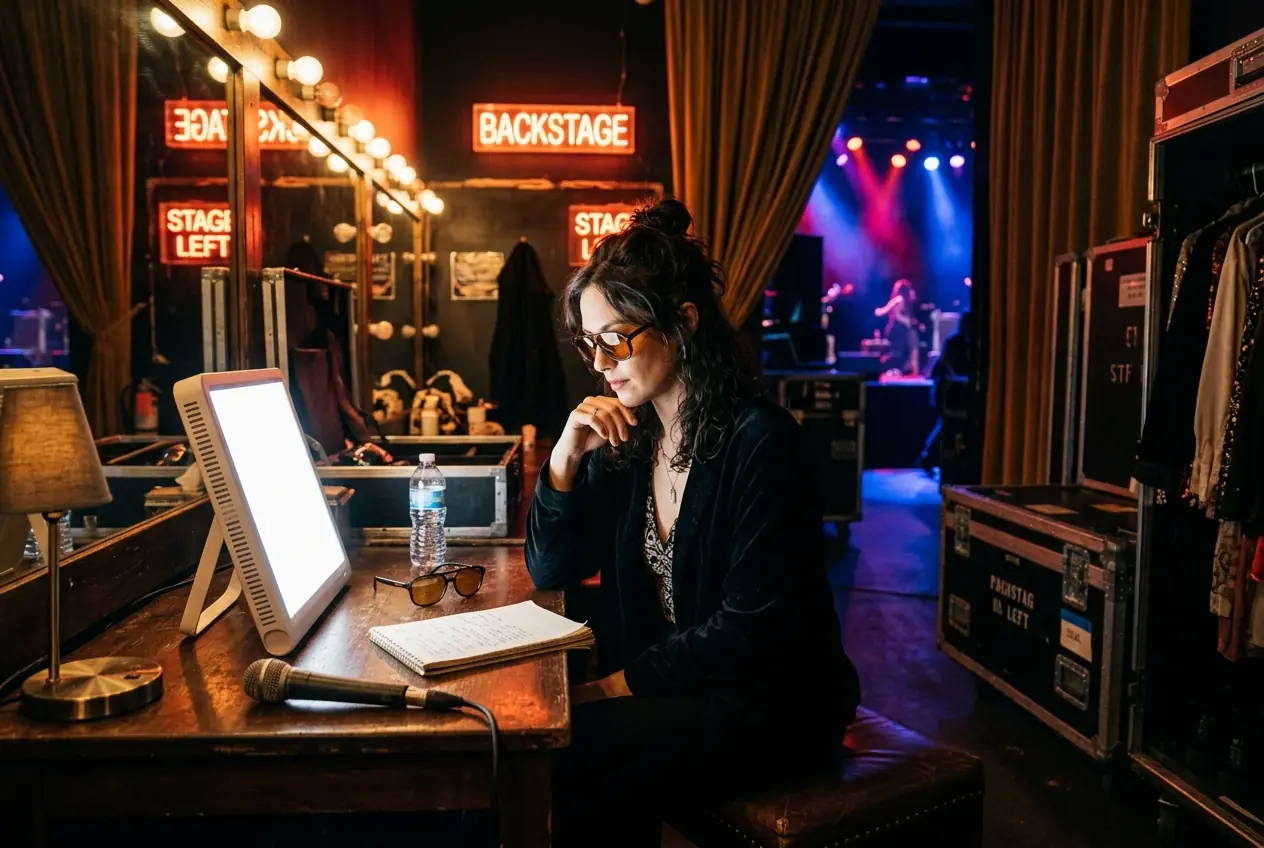
1. The Circadian Crisis of the Traveling Performer
A world tour, a high-stakes film festival junket, or an extended run of overnight soundstage shoots forces the human nervous system into an extreme ecological contradiction. Within the span of 24 hours, a performer may cross eight time zones or flip their wake-sleep architecture 180 degrees.
Under ordinary conditions, human physiology is tightly governed by the Suprachiasmatic Nucleus (SCN)—a cluster of roughly 20,000 neurons situated in the anterior hypothalamus. The SCN acts as the master conductor, regulating the circadian transcription-translation feedback loops (CLOCK/BMAL1 and PER/CRY) across every organ. When social schedules demand peak physical performance during the biological nadir, the master clock and peripheral tissue systems fall out of sync.
The consequences are severe for artists whose livelihood depends on cognitive agility and vocal stamina:
Nocturnal cortisol blunting impairs tissue repair in vocalis muscles, reducing vocal range and precipitating phonotrauma during stage sets.
Circadian misalignment suppresses hippocampal neuroplasticity and dlPFC working memory, causing sudden lyric lapses and delayed physical choreography.
Late-night catering consumed during the biological night leads to insulin insensitivity, severe fluid retention, and systemic digestive discomfort.
2. The Master Regulator: Suprachiasmatic Nucleus & Light PRCs
The primary environmental cue (zeitgeber) that resets the master clock is light. Photons hit the retina and are detected by specialized intrinsically photosensitive retinal ganglion cells (ipRGCs) expressing the photopigment melanopsin (peak sensitivity at 460–480 nm blue wavelengths). These ipRGCs project directly to the SCN via the retinohypothalamic tract.
However, light does not simply "wake the brain up"—its effect on the internal clock depends strictly on when it is received relative to the Core Body Temperature Minimum (Tmin). Tmin is the physiological anchor of our internal circadian day, typically occurring two to three hours before customary wake time.
The Khalsa Phase Response Curve Evidence
In landmark human clinical trials conducted at Harvard Medical School, Khalsa and colleagues (Khalsa et al., 2003, PMID: 12717008; PMC2342968) mapped the precise human Phase Response Curve (PRC) to bright light pulses:
- Phase Delay Region (Pre-Tmin): Exposing the eyes to high-lux blue-enriched light in the biological evening or early night (before Tmin) shifts the clock later. This is essential when preparing for westward flights or transitioning into night filming.
- Phase Advance Region (Post-Tmin): Exposing the eyes to bright light in the late biological night or early morning (after Tmin) pulls the clock earlier. This is the cornerstone protocol for eastward international flights.
- The Crossover Singularity: Light administered right at Tmin can cause erratic, unstable shifts or severe circadian dampening. Timing must be engineered with clinical precision.
If a performer flying from Los Angeles to London steps out into bright morning sunlight before their internal Tmin has shifted, that light will fall into their biological delay zone—pushing their clock further toward California time and worsening their jet lag.
3. Melatonin Phase Response Curves & Micro-Dosing Titration
While light is the primary phase accelerator, exogenous melatonin is the primary biochemical brake. Melatonin acts directly on MT1 and MT2 G-protein-coupled receptors in the SCN to modulate neuronal firing.
In commercial travel culture, people routinely consume massive doses (5 mg to 10 mg) of melatonin right before getting into bed. Clinical chronobiologists caution against this practice: excessive doses saturate receptors for 8 to 10 hours, creating spillover into the opposite phase zone, inducing residual morning sedation, and causing intense vivid nightmares.
The Burgess & Eastman Clinical Trials
Research led by Dr. Helen Burgess and colleagues at Rush University Medical Center examined phase shifting across different dosages (Burgess et al., 2010, PMID: 20410229; PMC2928909; Burgess et al., 2008, PMID: 18006583):
Administered 2 to 4 hours before endogenous Dim Light Melatonin Onset (DLMO), a 0.5 mg micro-dose triggers an average 1.5-hour phase advance, equal in efficacy to higher doses without receptor desensitization.
Administered in the biological morning (roughly 11 hours after DLMO), melatonin induces a mild phase delay, facilitating adjustment to westward travel or late night shoot calls.
By pairing micro-dosed melatonin with targeted light exposure, performers can safely accelerate their circadian re-entrainment rate from the natural 1 hour per day to 2.5 to 3 hours per day.
4. Peripheral Clock Protection: The Scheer & Damiola Metabolic Evidence
Many touring crews focus exclusively on light and sleep, yet ignore the second master regulatory network: the food-entrainable oscillator (FEO).
Pioneering molecular biology by Damiola and colleagues (Damiola et al., 2000, PMID: 11114885; PMC317100) demonstrated that restricted feeding completely uncouples peripheral circadian oscillators—such as liver gene expression (PER1, PER2)—from the SCN. While light governs the brain, calorie intake governs the gut and liver.
When a performer eats a heavy meal at 3:00 AM on set, their liver clocks reset to "daytime" while their hypothalamus registers biological night. In clinical trials at Brigham and Women's Hospital, Scheer and colleagues (Scheer et al., 2009, PMID: 19255424; PMC2657421) documented the severe consequences of this internal misalignment:
Circadian Misalignment Biomarkers: During laboratory-controlled shift misalignment, participants experienced an immediate 17% decrease in circulating leptin (satiety hormone), a 6% spike in mean arterial blood pressure, and a marked decline in glucose tolerance, with several subjects exhibiting pre-diabetic postprandial glucose curves.
For touring performers, maintaining a defined fasting window during the biological night prevents peripheral clock fracture and protects vocal and metabolic longevity.
5. The Performer Protocol: Field Guide for Night Shoots & Global Tours
To operationalize these insights in high-pressure entertainment environments, Coach Caren implements a two-pronged operational framework:
🌙 PROTOCOL A: The "Vampire Shift" (Overnight Film Shoot / Late Concert)
- Pre-Call Retinal Pulse (4:00 PM – 5:30 PM): Before heading to the soundstage or arena, expose eyes to 10,000 lux broad-spectrum light or natural afternoon sky for 30 minutes to suppress melatonin and anchor the evening shift.
- Backstage Mid-Shift Fasting (12:00 AM – 5:00 AM): Strictly avoid solid caloric meals between midnight and wrap. Rely exclusively on warm herbal infusions, electrolyte water, and essential amino acids (EAAs) to prevent liver clock uncoupling.
- The Dawn Wrap Shield (6:00 AM): Before stepping out of the soundstage into morning sunlight, don dark-therapy glasses blocking 100% of 450–480 nm light. Shielding the eyes prevents unwanted morning phase advance.
- Sleep Chamber Physics (7:00 AM – 2:00 PM): Sleep in a blackout environment (<1 lux) with ambient room temperature lowered to 65°F (18°C) to support core body cooling.
✈️ PROTOCOL B: Transmeridian Rapid Shifting (Eastbound Tour Flight)
- Pre-Departure Phase Advance (Days -2 & -1): Wake 1.5 hours earlier each morning and immediately get 30 minutes of high-lux light. Administer 0.5 mg melatonin at 6:00 PM (3 hours before normal DLMO).
- In-Flight Fasting: Fast completely during the airborne transit window. Rehydrate with sodium and potassium electrolytes.
- Destination Meal Anchor: Consume a protein-rich meal at the destination's normal breakfast hour to entrain peripheral liver clocks to the new geographic meridian.
6. Frequently Asked Questions: Performer Chronobiology & Phase Shifts
How can I estimate my Core Body Temperature Minimum (Tmin) without rectal thermometry? ↓
For individuals on a stable sleep schedule, Tmin occurs approximately 2 to 3 hours prior to your natural, unalarmed waking time. For example, if you naturally wake up at 7:00 AM, your Tmin is roughly 4:30 AM. Light exposure after 4:30 AM will phase-advance your clock, while light exposure between 9:00 PM and 4:30 AM will phase-delay it.
Should I use sleeping pills to sleep during the day between night shoots? ↓
Pharmaceutical hypnotics (such as z-drugs or benzodiazepines) induce sedation by allosterically modulating GABA-A receptors, but they suppress restorative slow-wave sleep and REM architecture. They also carry high risk of next-day cognitive fogginess and motor impairment on set. A combination of dark-therapy glasses at wrap, cold room temperature, 0.5 mg melatonin, and a 15-minute NSDR autonomic reset provides far more restorative daytime sleep.
Can red light therapy panels substitute for bright light during morning phase advances? ↓
No. The retinal ganglion cells that reset the SCN express melanopsin, which is virtually insensitive to red wavelengths (630–660 nm). To achieve a circadian phase shift, the light spectrum must include short-wavelength blue-cyan light (460–480 nm) at an intensity of at least 1,000 to 10,000 lux. Red light is superb for evening work because it does not suppress melatonin, but it cannot drive a phase advance.
How should a performer handle stage lighting if it occurs during their biological night? ↓
Intense stage spotlights deliver thousands of lux directly to the retina, generating a powerful phase delay. Performers should embrace this photon stimulus during the performance to maintain maximal adrenergic alertness and vocal energy. The crucial intervention occurs immediately after the show: switch dressing rooms to low-lux warm lighting (<30 lux) and avoid looking at mobile screens without blue-blocking filters.
Clinical Evidence & Peer-Reviewed Literature
- The Journal of Physiology: Khalsa SBS, Jewett ME, Cajochen C, Czeisler CA. A phase response curve to single bright light pulses in human subjects. J Physiol. 2003. PMID: 12717008; PMCID: PMC2342968.
- The Journal of Clinical Endocrinology & Metabolism: Burgess HJ, Revell VL, Molina TA, Eastman CI. Human phase response curves to three days of daily melatonin: 0.5 mg versus 3.0 mg. J Clin Endocrinol Metab. 2010. PMID: 20410229; PMCID: PMC2928909.
- The Journal of Physiology: Burgess HJ, Revell VL, Eastman CI. A three pulse phase response curve to three milligrams of melatonin in humans. J Physiol. 2008. PMID: 18006583; PMCID: PMC2375577.
- Proceedings of the National Academy of Sciences (PNAS): Scheer FA, Hilton MF, Mantzoros CS, Shea SA. Adverse metabolic and cardiovascular consequences of circadian misalignment. Proc Natl Acad Sci USA. 2009. PMID: 19255424; PMCID: PMC2657421.
- Genes & Development: Damiola F, Le Minh N, Preitner N, Kornmann B, Fleury-Olela F, Schibler U. Restricted feeding uncouples circadian oscillators in peripheral tissues from the central pacemaker in the suprachiasmatic nucleus. Genes Dev. 2000. PMID: 11114885; PMCID: PMC317100.