Alpha Wave Entrainment: Binaural Beats, Pink Noise & Auditory Steady-State Neuromodulation
Deconstructing the neurophysics of auditory brainwave stimulation: how 10 Hz alpha oscillations gate sensory distractions, why pink noise outperforms white noise, and when to deploy 40 Hz gamma pulses for elite focus.
Key Neurological Takeaways
- The Alpha Inhibition Hypothesis: Dr. Ole Jensen's electrophysiological research proves that alpha rhythms (8–12 Hz) function as active inhibitory gates, functionally silencing irrelevant sensory cortices to protect prefrontal deep work.
- ASSR Mechanics: The Auditory Steady-State Response (ASSR) and Frequency-Following Response (FFR) operate through phase-locking in the superior olivary complex. Empirical trials show that monaural acoustic pulses drive stronger cortical entrainment than dichotic binaural beats.
- The 1/f Acoustic Architecture: Pink noise mimics the scale-invariant fractal dynamics of natural cortical power spectra, making it superior to flat white noise for masking acoustic startle without increasing cognitive load.
1. Acoustic Architecture in High-Stakes Knowledge Work
In the open-plan offices, airport executive lounges, and home work studios where modern technical and financial leaders operate, ambient auditory chaos is the primary destroyer of executive bandwidth. An unexpected telephone ring, distant conversational chatter, or construction noise triggers an involuntary acoustic startle reflex in the inferior colliculus, tearing the dorsolateral prefrontal cortex out of complex working memory arrays.
To shield their attentional focus, executives increasingly don active noise-canceling headphones and stream acoustic neuromodulation tracks—ranging from binaural beats and isochronic tones to colored noise generators. Yet widespread commercial marketing obscures the precise neurophysiology: what actually happens in the human cerebral cortex when exposed to rhythmic sound waves?
Navigating auditory entrainment requires moving beyond pop-science claims to understand how acoustic frequencies interact with internal bio-oscillators during structured 90-minute ultradian focus sprints.
2. Alpha Oscillations (8–12 Hz): The Sensory Gating Mechanism
Historically, electroencephalography (EEG) literature viewed alpha waves (8 to 12 Hz) as a passive indicator of cortical idling—the brain state observed when an individual merely closes their eyes in a quiet room.
This paradigm was revolutionized by the Inhibition-Timing Hypothesis formulated by Dr. Ole Jensen and Dr. Ali Mazaheri (published in Frontiers in Human Neuroscience, PMID: 20953245). Their research demonstrated that alpha oscillations represent an active, top-down sensory gating mechanism:
- Targeted Cortical Inhibition: When you engage in intense visual coding or financial modeling, alpha power does not decline everywhere. Instead, alpha power increases dramatically over the auditory cortex and somatosensory regions.
- The Pulsed Inhibitory Filter: High-amplitude alpha rhythms rhythmically suppress local neuronal firing in task-irrelevant cortical areas, effectively slamming the door on background distractions.
- Default Mode Network (DMN) Silencing: Robust alpha synchronization correlates with downregulation of task-negative DMN nodes, quieting internal rumination, past regrets, and future executive anxiety.
Consequently, inducing an alpha-dominant state produces "relaxed alertness"—a calm, highly stable psychological posture where cognitive throughput is maximized without sympathetic panic. When sustained across grueling days, maintaining this calm prevents the dopaminergic exhaustion discussed in our guide to dopamine resensitization.
3. The Electrophysiology of Binaural Beats vs. Monaural Pulses
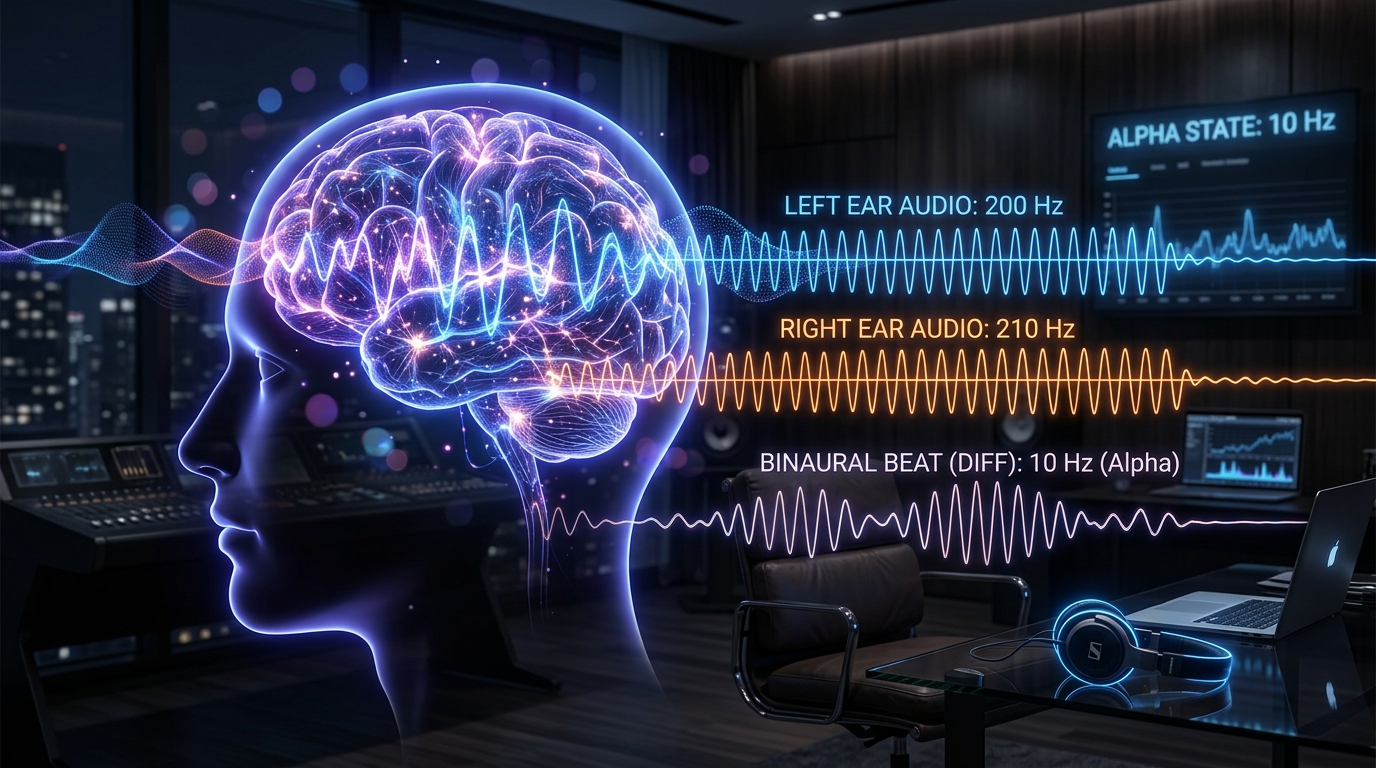
A binaural beat is an auditory illusion generated when two pure sine waves of slightly different frequencies are delivered dichotically (one tone to each ear). For example, delivering 200 Hz to the left ear and 210 Hz to the right ear produces the perception of a 10 Hz beat pulsating within the brain.
Crucially, this beat does not exist in the physical acoustic environment. It is constructed centrally within the superior olivary complex (SOC) in the brainstem—the neurological nucleus responsible for interaural phase and timing comparison used for sound localization.
However, rigorous electrophysiological trials (eNeuro, 2020) evaluating the Auditory Steady-State Response (ASSR) and Frequency-Following Response (FFR) revealed a surprising reality:
Binaural Beats vs. Monaural Beats: The Empirical Truth
While binaural beats require headphones and generate modest brainstem phase-locking, monaural beats (where amplitude modulations are physically combined into the acoustic wave prior to reaching the eardrum) produce a significantly larger Auditory Steady-State Response (ASSR) in primary and secondary auditory cortices.
For pure cortical phase entrainment, isochronic pulses and monaural acoustic modulations drive measurable neural synchronization more reliably than dichotic binaural tracks.
4. The MIT 40 Hz Gamma Breakthrough: Microglial Activation
While alpha waves govern calm focus, the frontier of sensory entrainment lies at 40 Hz gamma. Pioneering investigations by Dr. Li-Huei Tsai's laboratory at the Massachusetts Institute of Technology (MIT Picower Institute for Learning and Memory) revealed extraordinary neuroprotective properties of 40 Hz sensory stimulation.
In preclinical models, delivering 40 Hz rhythmic auditory clicks or flickering light:
- Drove gamma oscillatory coherence across the primary auditory cortex, visual cortex, and hippocampus.
- Recruited and transformed microglia (the brain's resident immune cells) from an inactive state into an active, phagocytic phenotype, accelerating the clearance of toxic amyloid-beta oligomers.
- Significantly enhanced spatial memory, pattern recognition, and working memory performance.
For executives tackling complex analytical problem solving, short 15-to-30 minute exposures to 40 Hz auditory pulses can provide potent cognitive binding and acute attentional sharpening.
5. Noise Spectrum Physics: White vs. Pink vs. Brown
When entrainment tones feel fatiguing during 4-hour technical architecture sessions, synthetic colored noise offers the cleanest acoustic isolation. The distinction lies in spectral power density:
| Noise Spectrum | Power Spectral Distribution | Perceptual Profile | Ideal Executive Application |
|---|---|---|---|
| White Noise | Flat power; equal energy per frequency (0 dB/octave) | Harsh, hissing TV static; high-frequency dominant | Acoustic masking in loud open-plan offices; fatiguing long-term |
| Pink Noise | 1/f power law; equal energy per octave (-3 dB/octave) | Balanced, soothing steady rainfall or rustling leaves | The Gold Standard: Enhances working memory via stochastic resonance |
| Brown Noise (Brownian) | 1/f^2 power law; heavily low-frequency (-6 dB/octave) | Deep, heavy rumbling waterfall or distant jet engine | High-anxiety de-escalation; transition into midday recovery states |
Why Pink Noise Dominates: Healthy biological systems—from heart rate variability intervals to neuronal firing cascades—exhibit scale-invariant 1/f fractal dynamics. Because pink noise mirrors the brain's endogenous electrical power spectrum, the auditory cortex accepts pink noise without expending working memory resources on active filtering, creating the optimal backdrop for sustained execution.
6. The Executive Auditory Focus Stack
To leverage auditory neurobiology across your working day, implement this three-phase protocol:
- Sprint Launch (Minutes 0–15): Stream 10 Hz alpha isochronic pulses or monaural beats at low volume (40–50 dB). This accelerates locus coeruleus stabilization and facilitates entry into focused flow.
- Deep Cognitive Sprint (Minutes 15–90): Transition into 1/f pure pink noise. Pink noise masks sudden ambient acoustic transients while allowing your prefrontal cortex to maintain deep analytical synthesis without acoustic fatigue.
- Downregulation Reset (Post-Sprint Recovery): Following your 90-minute focus block, remove headphones or transition into low-frequency brown noise paired with a 15-minute somatic reset, as detailed in our guide to Non-Sleep Deep Rest (NSDR).
Frequently Asked Questions: Auditory Entrainment & Cognitive Physics
What is the biological function of alpha oscillations during deep focus?
Under the Jensen & Mazaheri gating hypothesis, alpha waves (8–12 Hz) do not merely represent passive neural idling; they serve as an active pulsed inhibitory filter. Alpha power increases over task-irrelevant sensory cortices to suppress distractive environmental noise, allowing the prefrontal cortex to direct working memory toward complex computation.
Are binaural beats more effective than pink noise for sustained cognitive work?
Binaural beats rely on central auditory integration in the superior olivary complex to create a perceived frequency differential, requiring stereo headphones. Pink noise, with a balanced 1/f power spectrum, provides acoustic startle masking and stochastic resonance without cognitive distraction, making pink noise superior for long multi-hour analytical sprints.
What does MIT research say about 40 Hz gamma entrainment?
Pioneered by Dr. Li-Huei Tsai's laboratory at MIT, 40 Hz auditory and visual stimulation drives gamma oscillations across the auditory cortex and hippocampus. In preclinical models, 40 Hz rhythmic pulsing recruited microglia to clear amyloid debris and enhanced working memory performance.